
£695.00
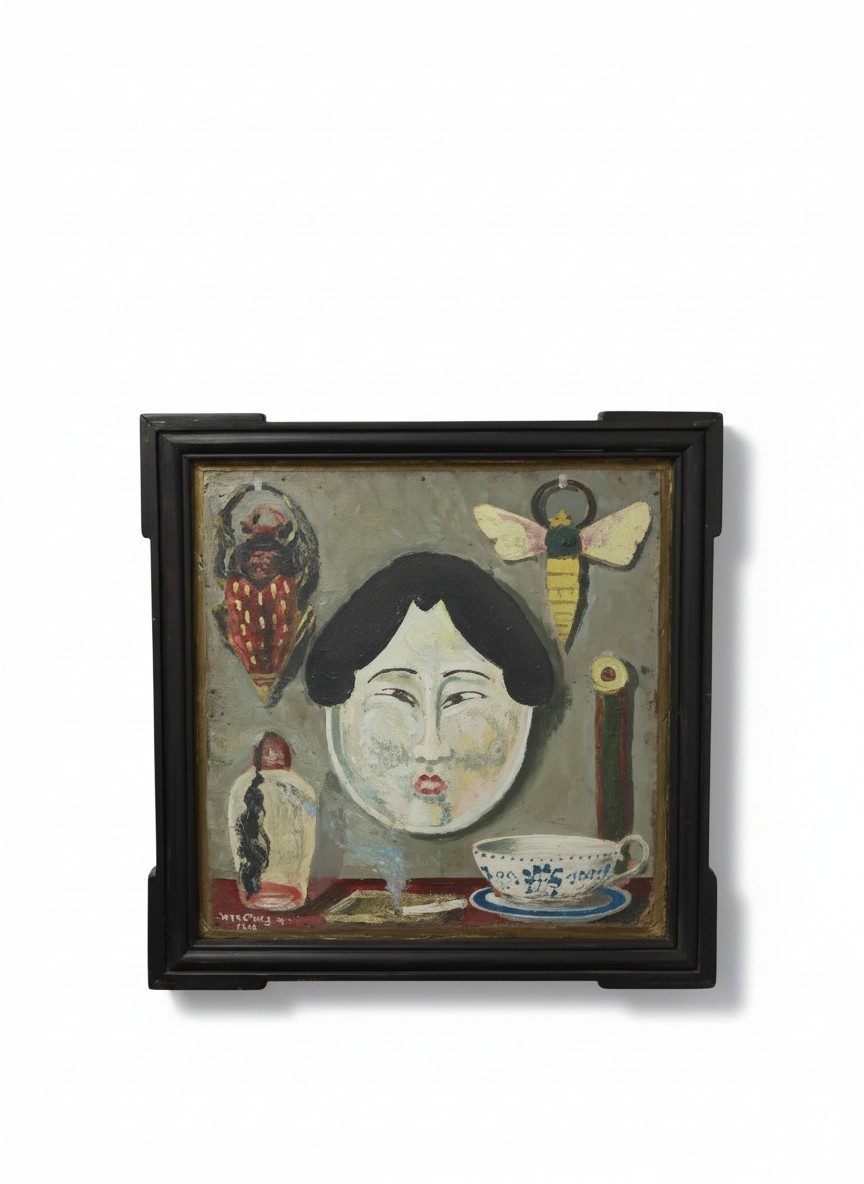
A wonderfully enigmatic and highly individual mid-20th-century oil on board by V. Khanotsky, signed and dated 1969, combining portraiture, still life and curious symbolic imagery within a wonderfully naïve modernist composition.



A wonderfully enigmatic and highly individual mid-20th-century oil on board by V. Khanotsky, signed and dated 1969, combining portraiture, still life and curious symbolic imagery within a wonderfully naïve modernist composition.
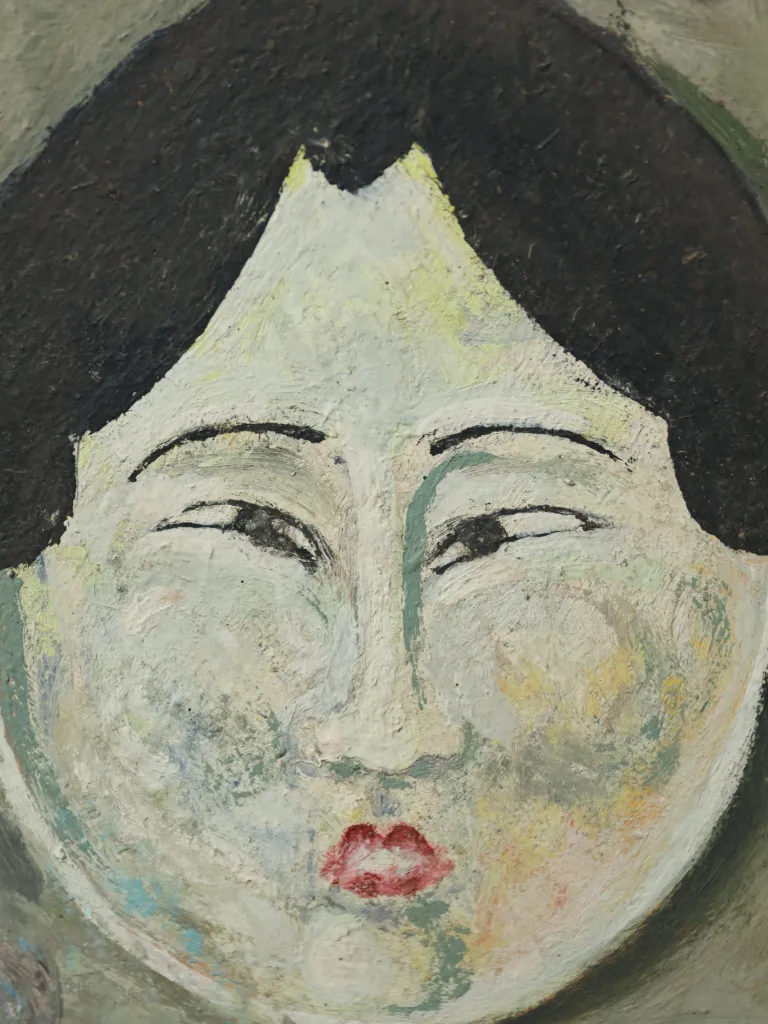
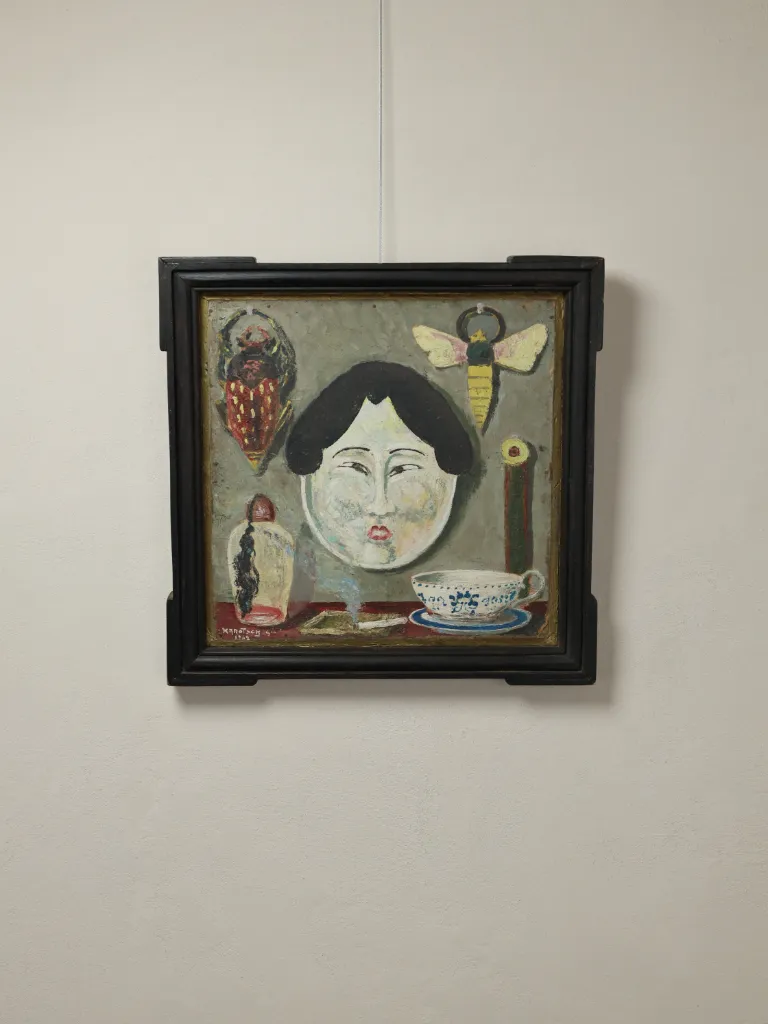
At the centre of the painting is a large, mask-like female face, framed by an expanse of jet-black hair and set against a muted grey-green ground. Her elongated dark eyes, arched brows and small crimson lips have been rendered with remarkable economy, while layers of chalky white, pale blue, ochre, pink and green give the complexion an unexpectedly complex and beautifully textured surface.
Surrounding the face is an extraordinary collection of objects and creatures.
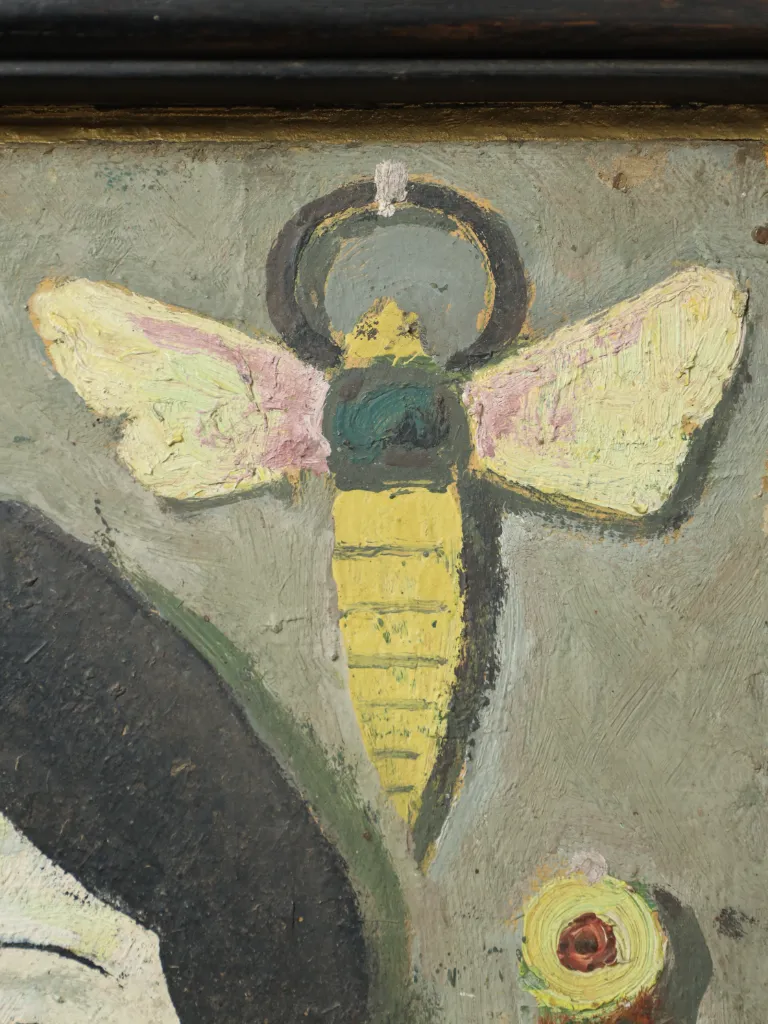
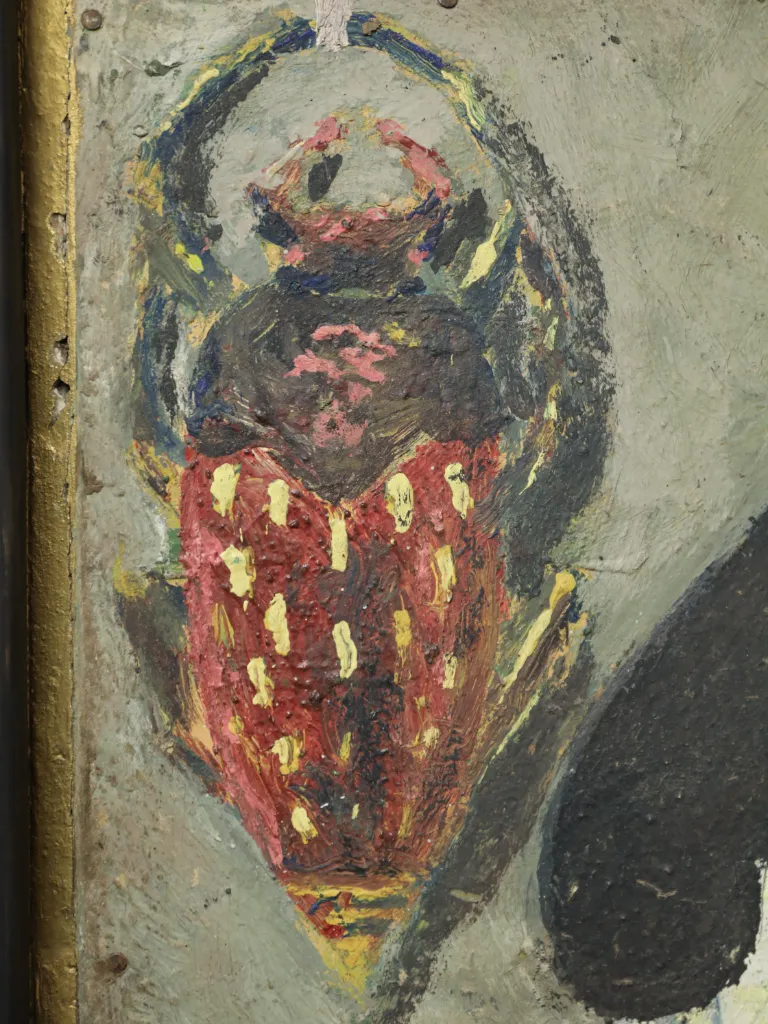
Above her to the right hovers a large winged insect, perhaps a moth, painted in yellow, cream, pink and deep green. Opposite is a richly coloured beetle-like form, its dark body emerging from a striking red and yellow lower section.
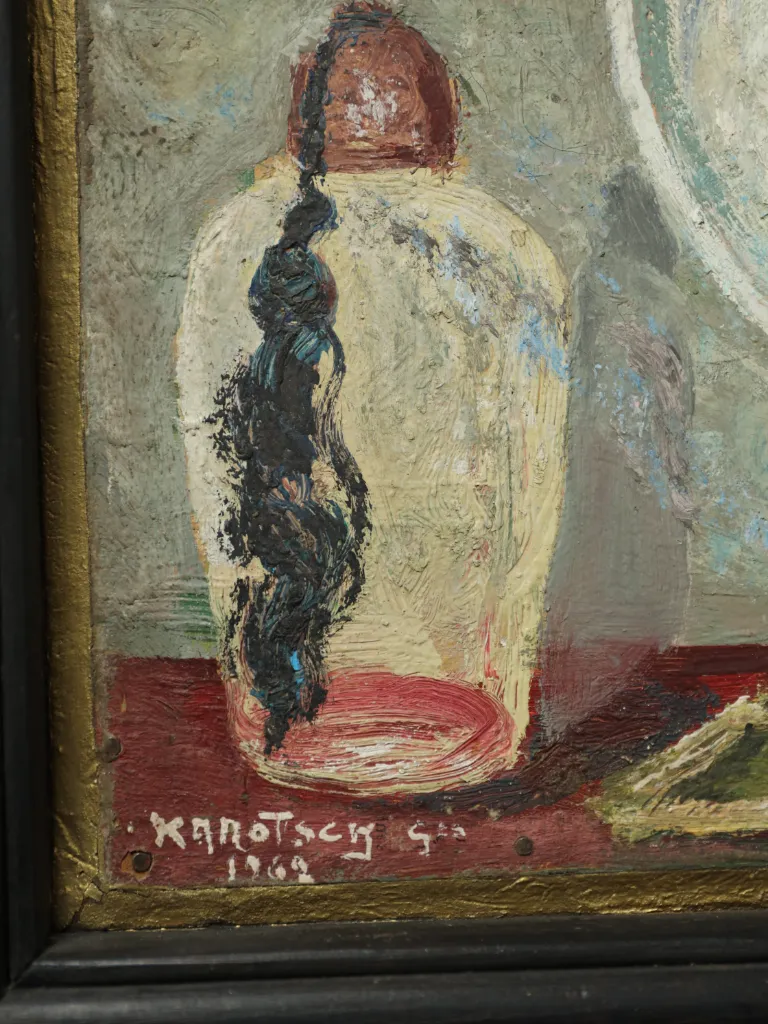
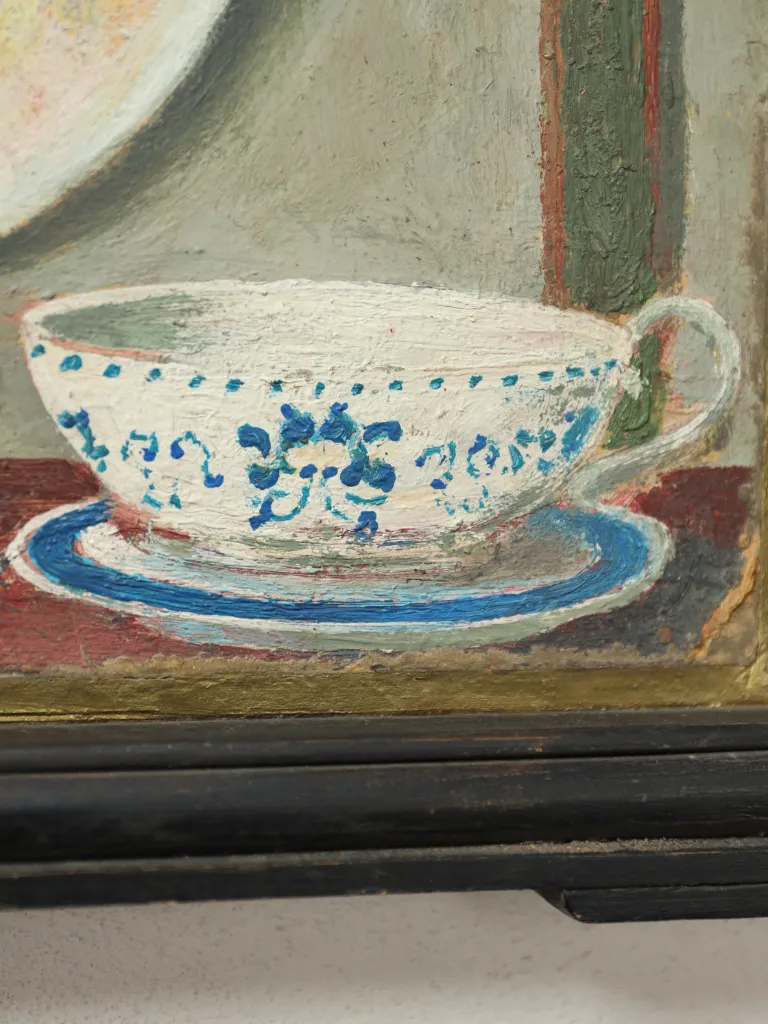
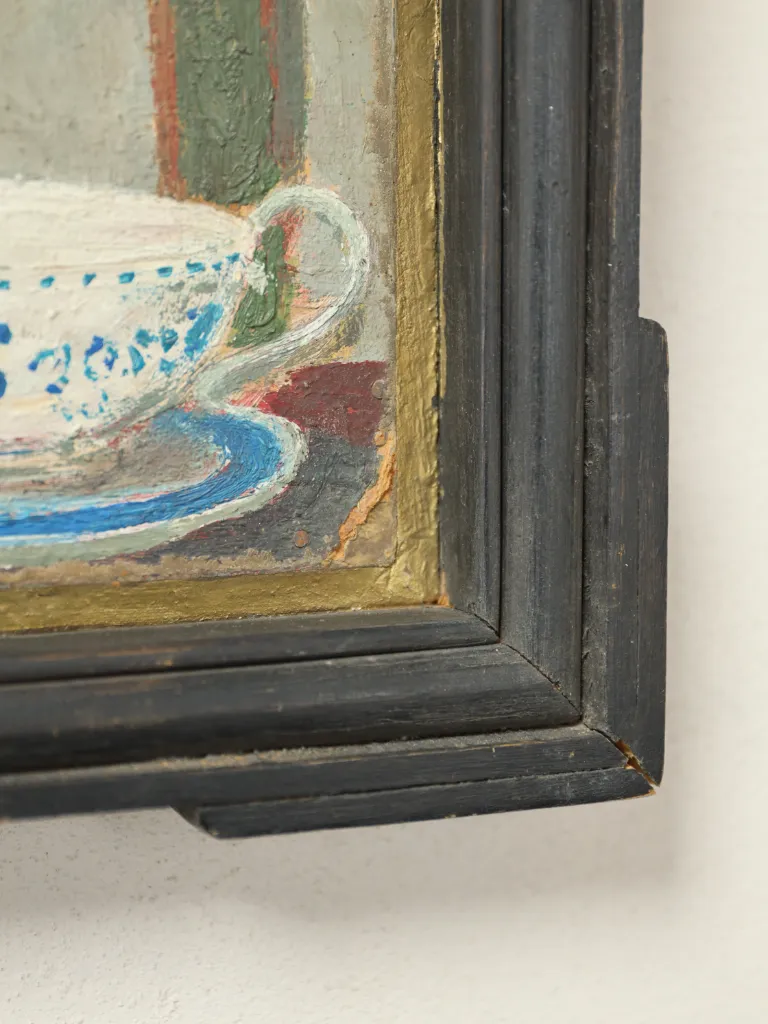
Below sits a pale bottle or vessel containing an unidentified dark form, while on the opposite side a wonderfully painted blue-and-white teacup and saucer introduces an unexpectedly domestic note.
Further small objects rest upon the deep red surface beneath the portrait, some immediately recognisable and others deliberately difficult to interpret.
The result is a painting that seems to sit somewhere between portrait, still life and cabinet of curiosities.
Khanotsky makes little attempt to create conventional perspective.
Instead, the objects appear to float around the central face, arranged according to their visual importance rather than their relationship to a realistic interior.
This flattened construction gives the painting much of its naïve character. Yet the composition itself is remarkably controlled.
The enormous pale face anchors the centre of the work, balanced by the two insect forms above and the bottle and teacup below. The muted grey-green background unifies the composition, allowing flashes of cobalt blue, crimson, yellow and pink to punctuate the surface.
There is something almost icon-like about the woman's presentation.
Her face is frontal and still, while the objects surrounding her take on an almost symbolic quality. Whether they held a particular personal meaning for Khanotsky or were simply assembled for their visual qualities is unknown, and it is this ambiguity that makes the painting particularly compelling.
It invites interpretation without ever providing a straightforward explanation.
Seen closely, the painting becomes even more interesting.
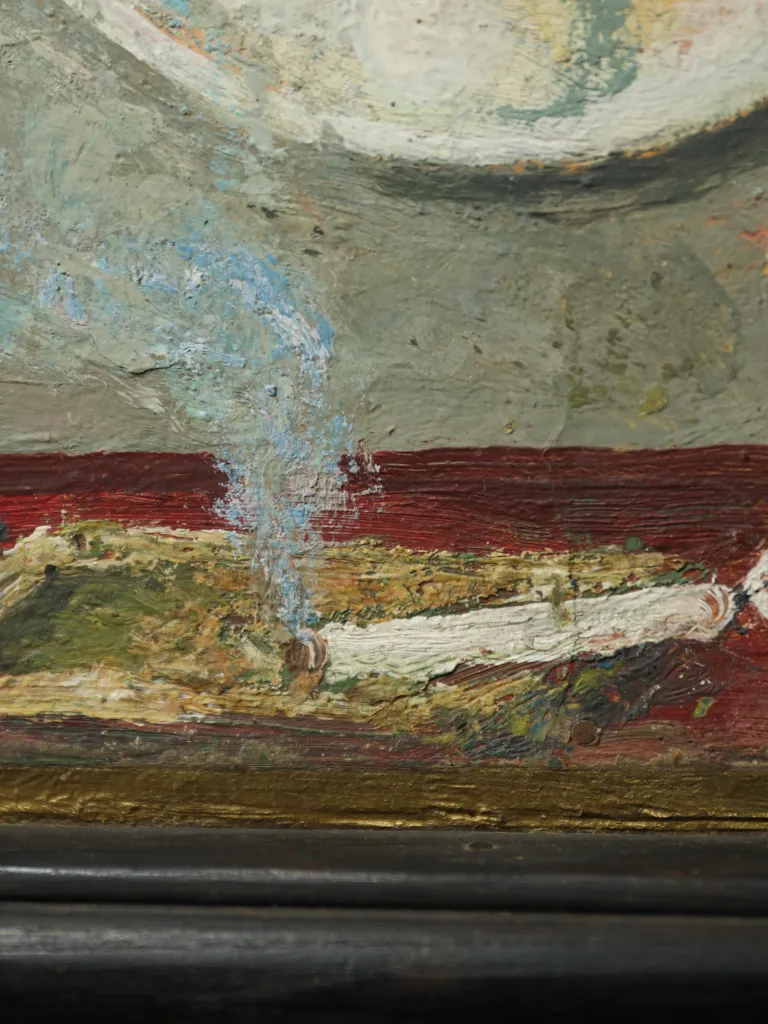
Khanotsky has built the image through repeated layers of paint, leaving previous colours, alterations and individual brushstrokes visible throughout.
The woman's complexion contains passages of blue, turquoise, yellow, pink and grey beneath the predominantly pale surface. The insects are constructed from thick strokes of contrasting colour, while the blue decoration of the teacup is reduced to a series of wonderfully economical marks.
Areas of impasto sit alongside thinner, rubbed and scraped passages, creating a surface with considerable depth and texture.
There is no attempt to disguise the physical process of painting.
It gives the work an immediacy and spontaneity that is particularly characteristic of naïve and self-taught artistic traditions, while the unusual arrangement and simplified forms give it a distinctly modernist quality.
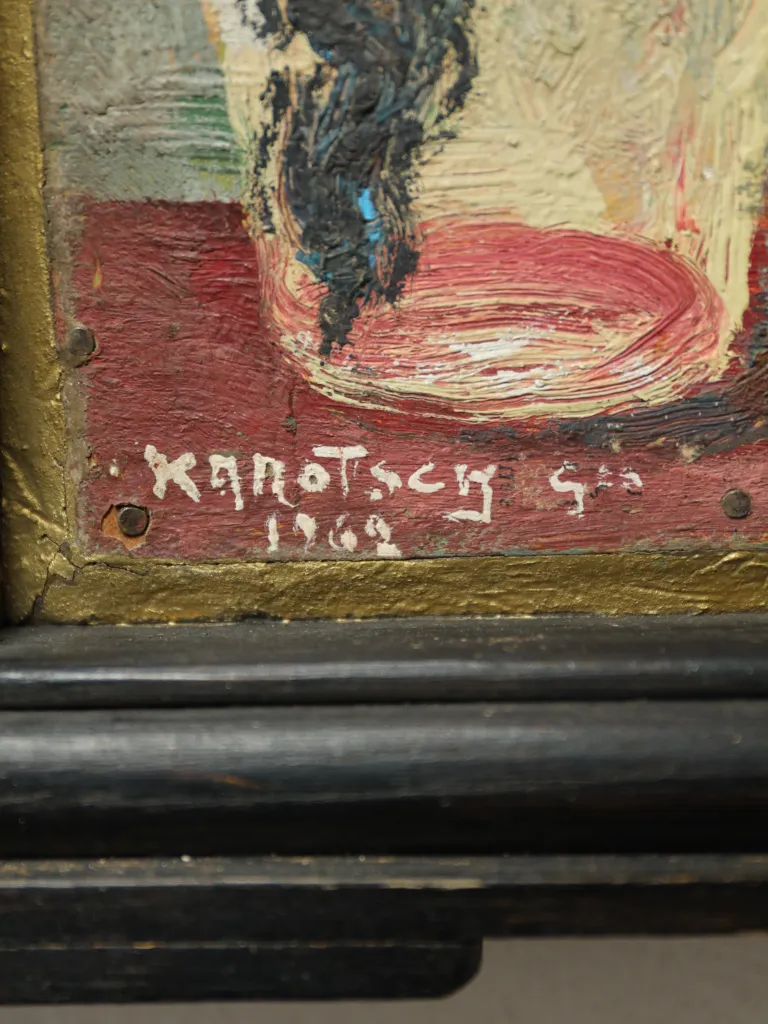
The painting is clearly signed V. Khanotsky and dated 1969 to the lower left.
Reliable published biographical information concerning Khanotsky remains scarce, and we have deliberately avoided assigning the artist a nationality, school or biography that cannot presently be substantiated.
What survives in the painting itself, however, reveals an artist with a highly distinctive visual language.
The combination of simplified drawing, mask-like portraiture, heavily worked paint and apparently unrelated surrounding objects gives the composition a character quite unlike conventional portraiture of the period.
Rather than attempting to impose a definitive narrative upon the work, we have retained its ambiguity — one of the qualities that makes it so intriguing.
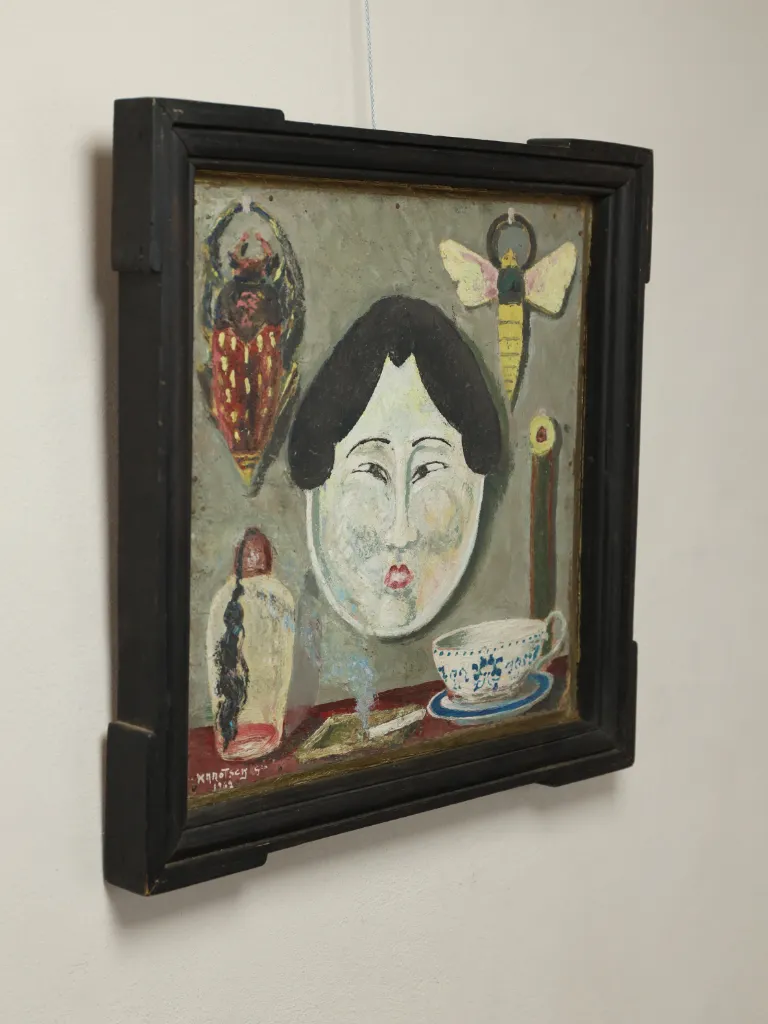
The painting is housed in a particularly characterful black-painted wooden frame.
Its strongly geometric construction incorporates projecting blocks around the outer edges, giving the frame an architectural quality that complements the unconventional painting extremely well.
A narrow gilt-painted inner border provides a subtle transition between the dark frame and the muted tones of the painted surface.
The frame displays the expected rubbing, knocks, marks and small areas of finish loss associated with age.
Oil on board, with the painted panel secured around its perimeter by small fixing pins.
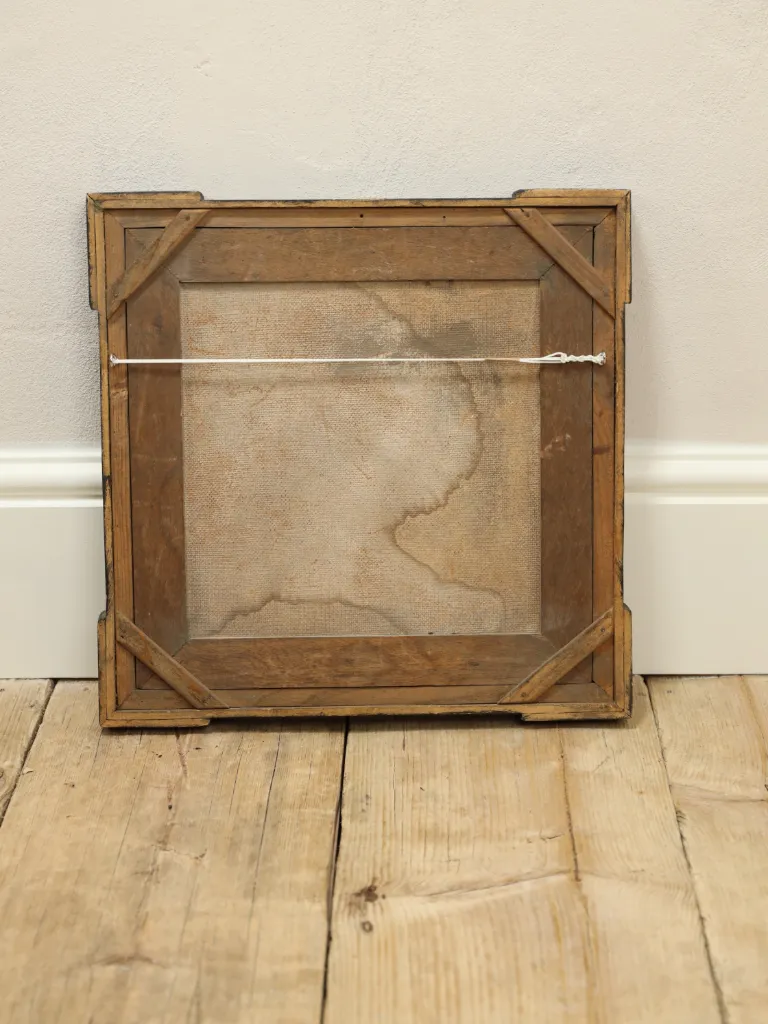
The reverse retains a coarse fbacking within the wooden frame construction, together with a later hanging wire.
The substantial period frame and simple construction are entirely sympathetic to the character of the painting.
The painting is presented in good vintage condition with a richly textured and highly characterful painted surface.
There are scattered age-related marks, minor abrasions, surface irregularities and areas of wear throughout. Much of the variation visible across the surface appears inherent to Khanotsky's heavily worked painting technique, with numerous underlying colours, brushstrokes and revisions intentionally remaining visible.
Small fixing pins are visible around the perimeter of the painted board and form part of its mounting.
The black-painted wooden frame displays rubbing, small knocks, marks, fading and areas of finish loss consistent with age. The fabric backing to the reverse shows staining and discolouration.
No attempt has been made to disguise the natural age and character of the work.
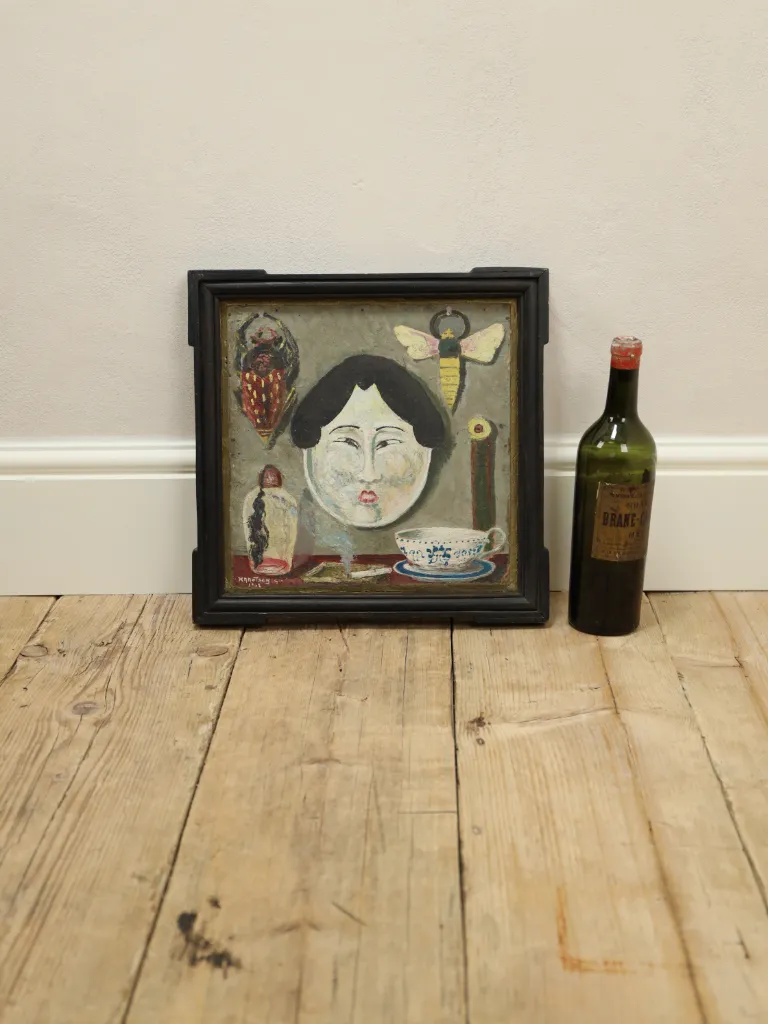
Height: 37 cm / 14.6 inches
Width: 37 cm / 14.6 inches
Depth: 3 cm / 1.2 inches
Weight: 0.8 kg / 1.8 lbs
Measurements are overall including the frame.
Every item offered by Shackleton Fox is carefully inspected, prepared, and where necessary conserved within our workshop prior to sale.
As heritage craftsmen and antique specialists, we believe in preserving the authenticity and integrity of each piece. Original finishes, patina, wear, and signs of age are retained wherever possible, as these elements contribute to both character and historical significance.
When restoration, rewiring, repairs, or conservation work is required, it is undertaken sympathetically using traditional techniques and materials appropriate to the period of the piece. Our philosophy is one of careful stewardship rather than unnecessary restoration, ensuring antiques remain both functional and historically respectful.
The result is a collection of pieces that have been thoughtfully prepared, allowing future owners to enjoy them with confidence while preserving their unique story and character.