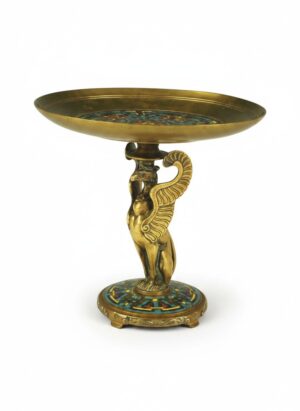
Cloisonné enamel is a decorative technique in which thin metal wires or strips are bent into patterns and fixed to a metal base, creating small compartments, or cloisons, that are filled with coloured enamel paste. The piece is fired, often several times as more enamel is added, and then ground and polished so that the wires and enamel form a smooth, colourful surface.
Cloisonné was practised in the ancient Near East and reached a peak of refinement in Byzantine goldsmiths' work, used for jewellery, reliquaries and religious objects. In China, cloisonné became an important court art from the Ming dynasty, with fifteenth-century pieces, particularly those associated with the Jingtai reign, regarded as among the finest, and production continued through the Qing dynasty for vases, censers, bowls and ritual objects. Japanese makers brought the technique to extraordinary refinement in the Meiji period, with very fine wires, subtle colours and pictorial designs, notably in the work of Namikawa Yasuyuki, and wireless techniques were also developed. European makers revived cloisonné in the nineteenth century for jewellery, boxes and decorative objects. Collectors look for fine, even wirework, rich colours, smooth enamel without pitting, and good gilding to exposed metal. Cracks, chips, dents and restoration, which can be difficult to see, significantly affect value.