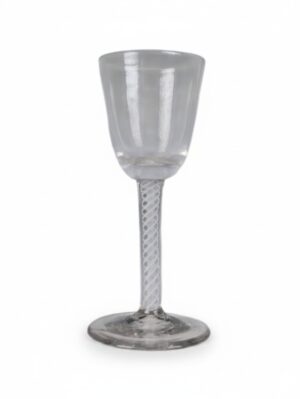
A Georgian wine glass is a hand-blown drinking glass made in Britain or Ireland between 1714 and 1837. Most are of lead glass, which has a soft, slightly dark tone, a pleasing weight and a clear ring when gently tapped, and each was formed by hand from a bowl, a stem and a foot.
Collectors classify Georgian wine glasses largely by their stems. Early examples have heavy baluster stems, followed by lighter balustroid and plain drawn stems in which the bowl and stem are pulled from one piece of glass. After the Glass Excise Act of 1745 taxed glass by weight, makers concentrated decoration in the stem, producing air-twist, opaque-twist, colour-twist and facet-cut stems from roughly the 1740s to the 1780s. Bowl shapes include trumpet, bell, round funnel, ogee and bucket, and bowls may be engraved with flowers, fruiting vines or, rarely, political and Jacobite emblems. Folded feet are typical of earlier glasses. Collectors look for a genuine pontil mark, signs of age wear beneath the foot, sharp and even twists, and freedom from chips or ground-down rims. Rare stem types and documented engraving are especially prized, but ordinary Georgian glasses can still be used and enjoyed at the table.