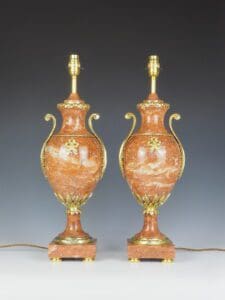













Green marble is a general term for decorative stone in shades of green, used for chimneypieces, columns, tabletops, plinths, clock cases and small objects. Strictly, many green marbles are in fact serpentine or serpentine breccias rather than true metamorphosed limestone, but the trade has long applied the word marble to any such stone that takes a high polish.
Verde antico, a dark green breccia streaked with white and quarried in ancient Thessaly, was prized by the Romans and reused in later Italian buildings, and it remained a favourite for neoclassical tabletops, columns and urns in the eighteenth and nineteenth centuries. Ireland's Connemara marble, with its swirling green markings, was widely used for small objects and decorative inlay, while Cornish serpentine from the Lizard was turned into vases, obelisks and lighthouse models for Victorian tourists. Buyers look for rich colour and attractive veining, a well-preserved polish and an absence of cracks, as serpentines in particular can be fragile along their veins and are vulnerable to acids, damp and frost. Scagliola and painted faux marbling were used to imitate the stone and should be identified correctly. In interiors, green marble pairs well with gilt bronze, mahogany and white statuary marble, and suits both classical and Art Deco schemes.