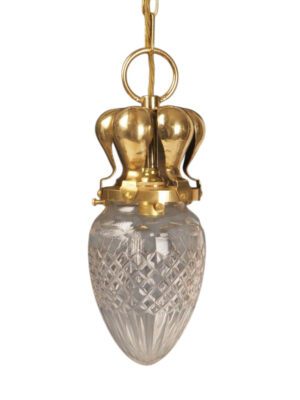
A hanging lamp is a light fitting suspended from the ceiling by a chain, rod, cord or set of arms, as opposed to a lamp that stands on a table or floor. In the antiques trade the term most often refers to Victorian and Edwardian oil lamps made to hang, but it also covers gas pendants, lanterns and early electric pendants.
Hanging oil lamps became common in the second half of the nineteenth century, after paraffin made bright, practical lighting widely available. Typical examples have a brass or iron frame supporting a glass or metal fount, a burner with a chimney and a large shade or globe, and many incorporate a rise-and-fall mechanism with counterweights or a spring, so that the lamp could be lowered for filling and lighting. They lit kitchens, halls, chapels and shops, and burners by Birmingham makers such as Hinks were widely used. Gas pendants and gasoliers followed similar patterns. Collectors look for original founts, burners, shades and chimneys, complete mechanisms and good brasswork. Many hanging lamps have been converted to electricity, and a sympathetic conversion that keeps the original parts intact is preferable. Converted lamps should always be rewired and tested by a qualified electrician, and secured to a fixing rated for their weight.