
£650.00
A wonderfully characterful mid-19th-century French folk art portrait of a young girl, traditionally identified by surviving family provenance as Berthe Houdart, who married Pierre Liser in 1854.



A wonderfully characterful mid-19th-century French folk art portrait of a young girl, traditionally identified by surviving family provenance as Berthe Houdart, who married Pierre Liser in 1854.
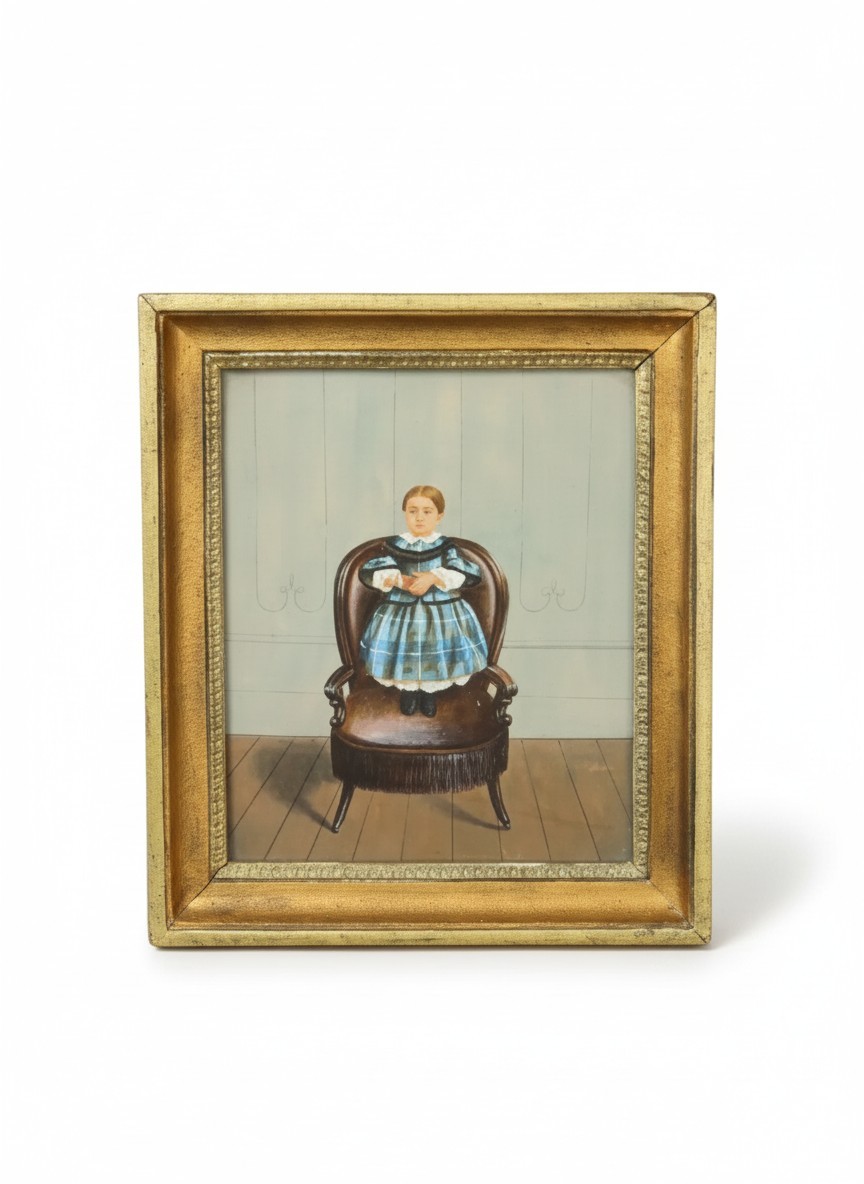
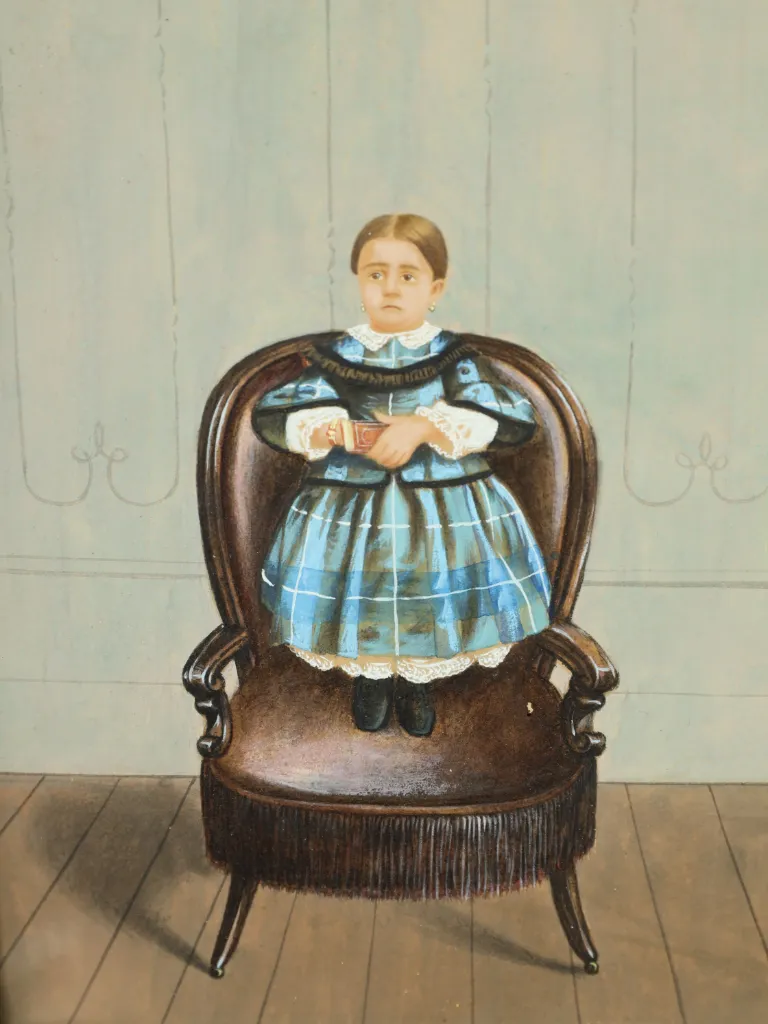
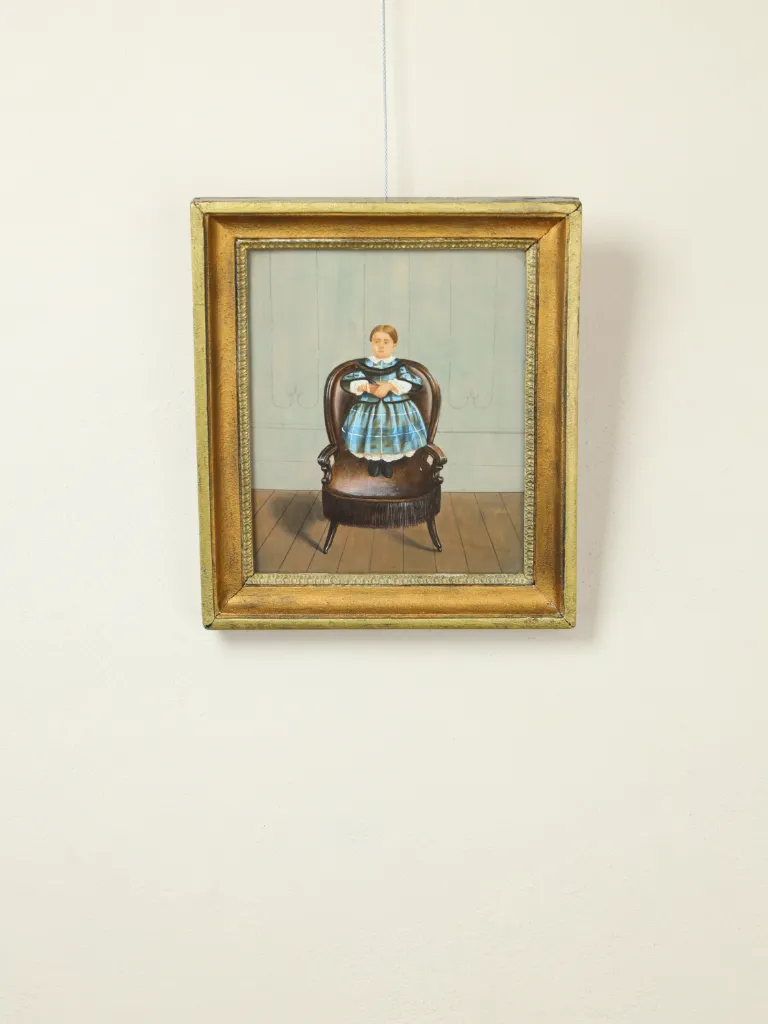
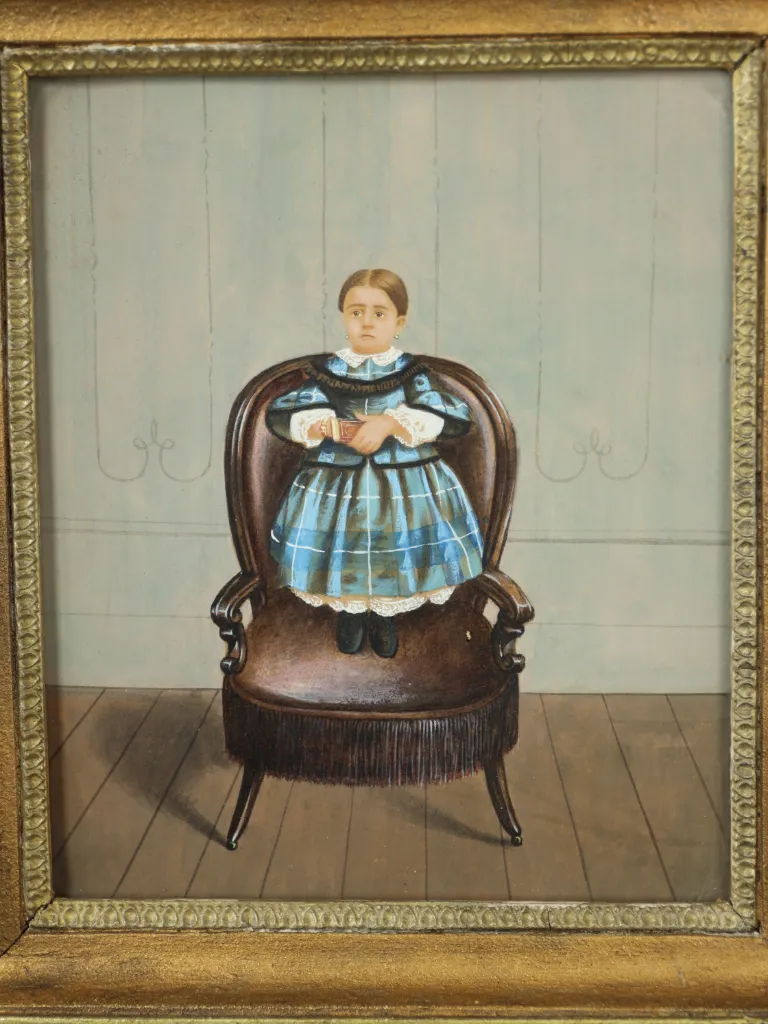
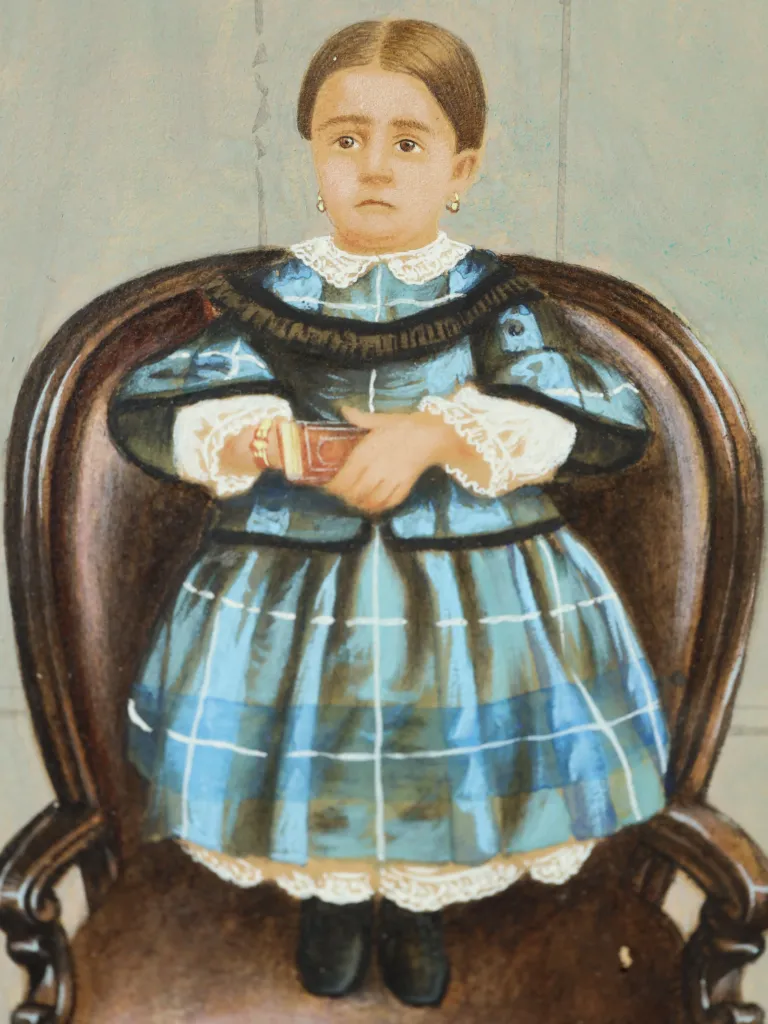
The young Berthe is depicted standing somewhat solemnly upon the seat of a large upholstered armchair, an unusual and wonderfully engaging composition that immediately gives the portrait its distinctive character.
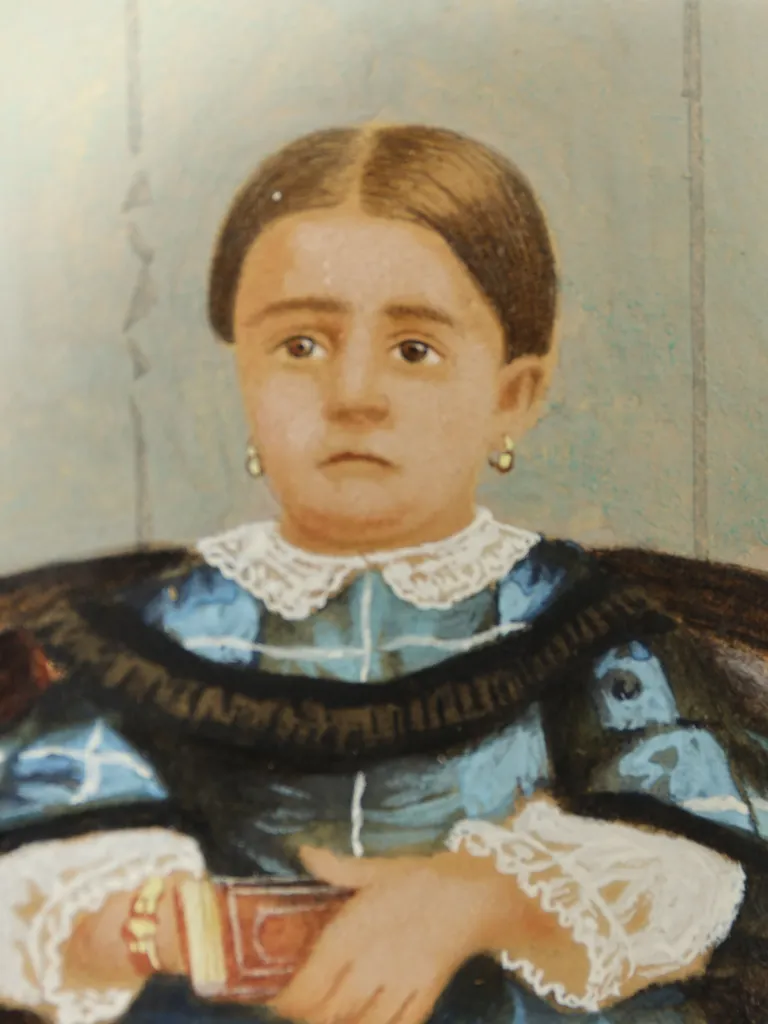
She wears an elaborate blue checked dress with a fitted bodice and full skirt, finished with delicate white lace at the collar, cuffs and hem. Her dark hair is carefully centre-parted and drawn back from her face, while a pair of small earrings provide a particularly charming detail.
Held carefully between her crossed hands is a small red-bound book, suggesting the importance placed upon both her appearance and education when the portrait was made.
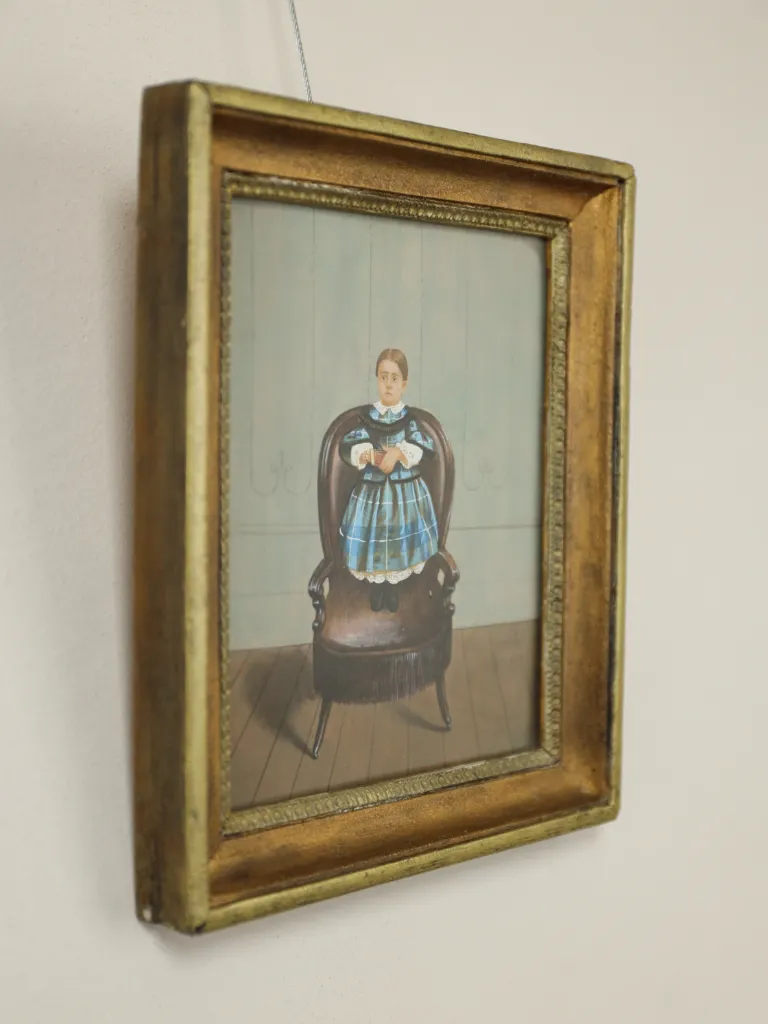
There is a wonderful disparity in scale between the diminutive child and the enormous chair upon which she stands. The chair almost envelops her, its sweeping back and curved arms framing the sitter and giving the composition an appealingly naïve quality.
Behind her, the interior has been reduced to its simplest elements. A pale blue-grey wall is articulated with delicate linear decoration, while the floorboards beneath the chair have been individually described. This restrained setting allows the extraordinary blue of Berthe's dress and the rich brown upholstery to dominate the composition.
The painting has the flattened perspective, direct observation and slightly unconventional proportions associated with 19th-century folk and naïve portraiture. Rather than diminishing its appeal, these qualities give the work its considerable individuality and decorative presence.
Particularly compelling is Berthe's expression. There is no attempt to idealise the young sitter; instead, she looks quietly beyond the viewer with the rather serious expression so often encountered in early childhood portraiture.
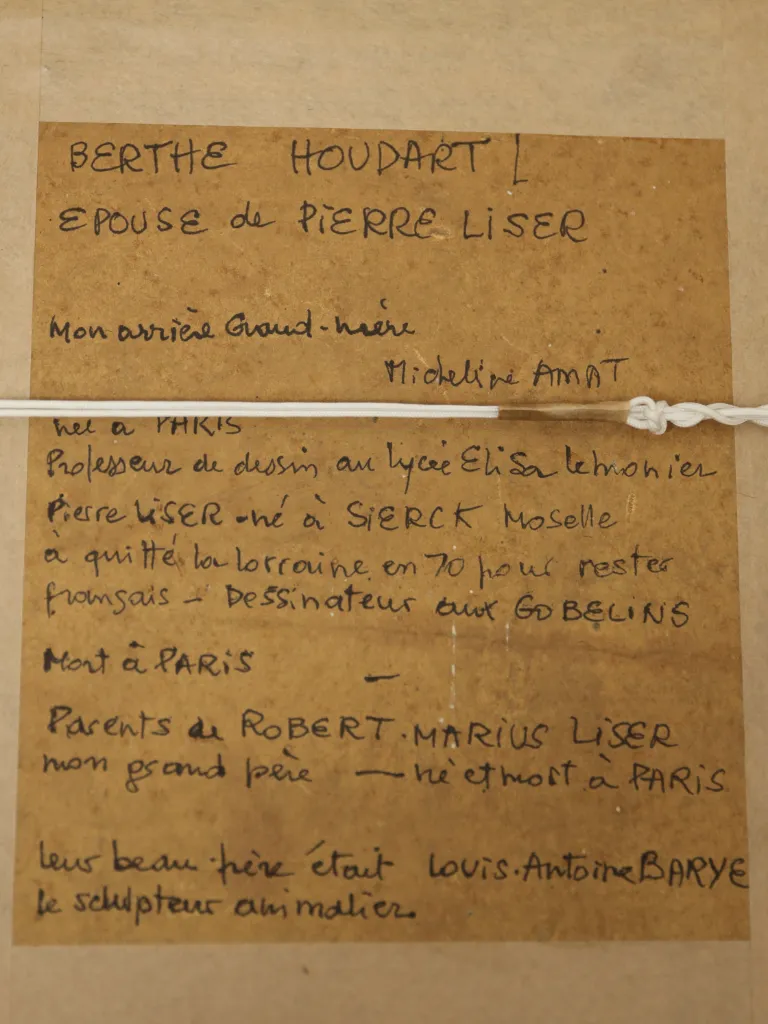
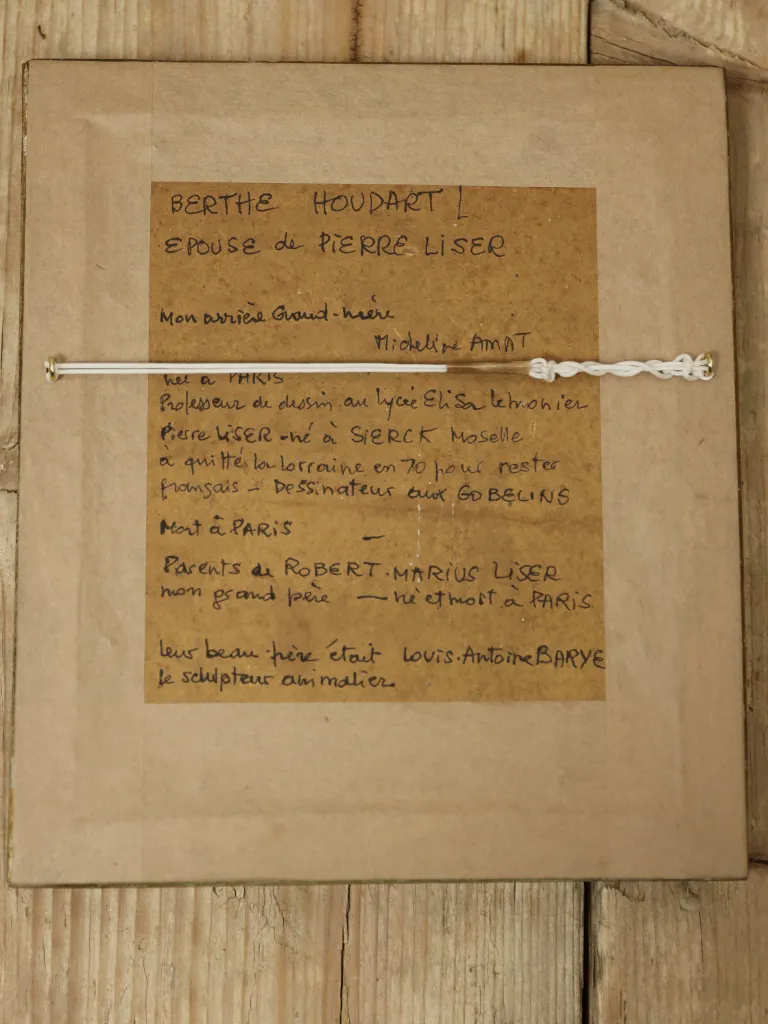
What makes this little portrait particularly interesting is the handwritten family history preserved on its reverse.
The inscription identifies the sitter as:
“Berthe Houdart – épouse de Pierre Liser”
and describes her as the writer's great-grandmother, with the note apparently signed or attributed to Micheline Amat.
Importantly, the principal identification can be supported independently. A Paris genealogical index records the marriage of Berthe Houdart and Pierre Liser in 1854, providing compelling supporting evidence for the names preserved with the portrait.
This marriage date also helps place the portrait earlier than we initially believed. Given Berthe's appearance as a young girl, a date of approximately 1840–1850 appears consistent with both the style of the work and the surviving family history.
The inscription continues with further details concerning Berthe's husband, Pierre Liser.
According to the family account, Pierre was born in Sierck, Moselle, left Lorraine as a young man and subsequently lived in Paris. He is also described as a draughtsman associated with the Gobelins.
The Liser surname is independently recorded in the Sierck and Sierck-les-Bains area, lending some contextual support to this part of the family history, although Pierre's stated association with the Gobelins has not presently been independently verified.
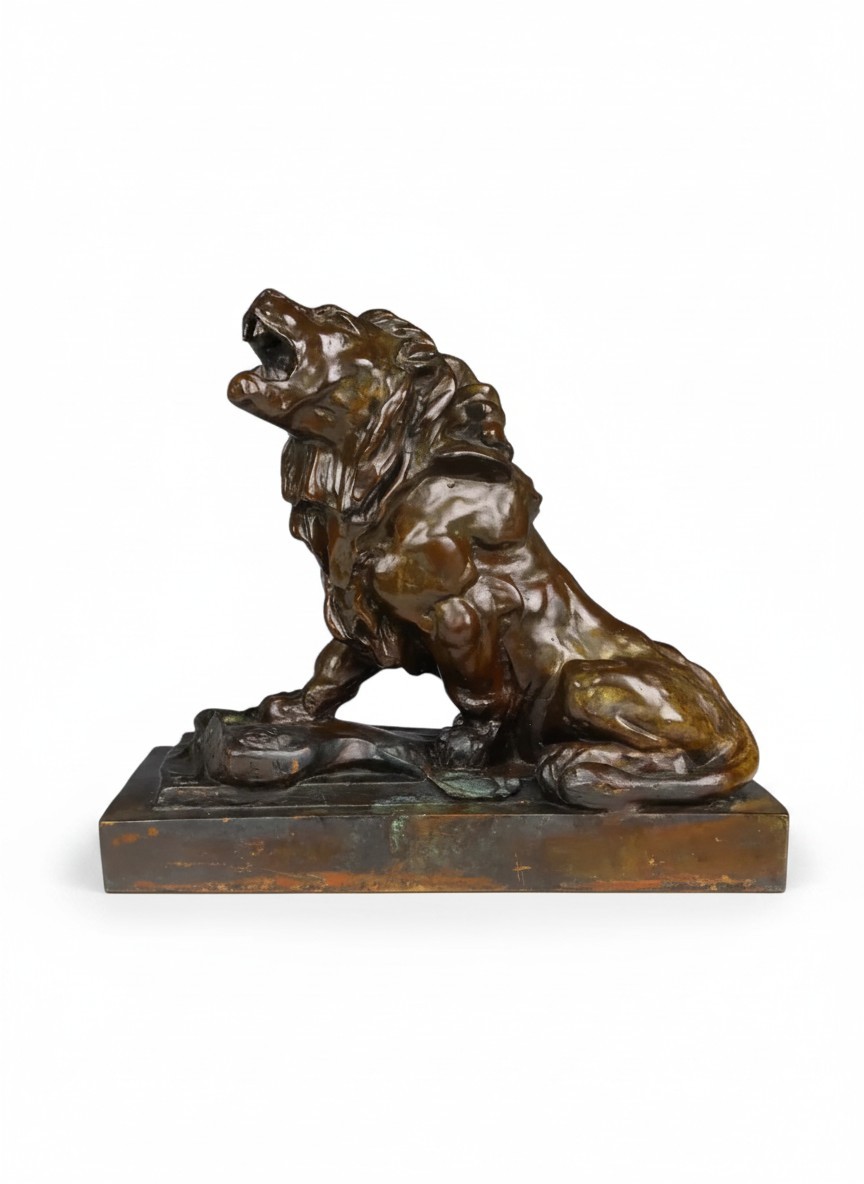
Most intriguingly, the family inscription records that a brother-in-law was Antoine-Louis Barye (1795–1875), the celebrated French Romantic sculptor and one of the great masters of the French animalier tradition.
This potentially fascinating family connection remains unverified, and we therefore present it as part of the family's recorded history rather than established provenance.
The survival of these handwritten notes nevertheless gives the portrait something often lost from anonymous 19th-century portraits: a tangible connection to the family for whom it was originally preserved.
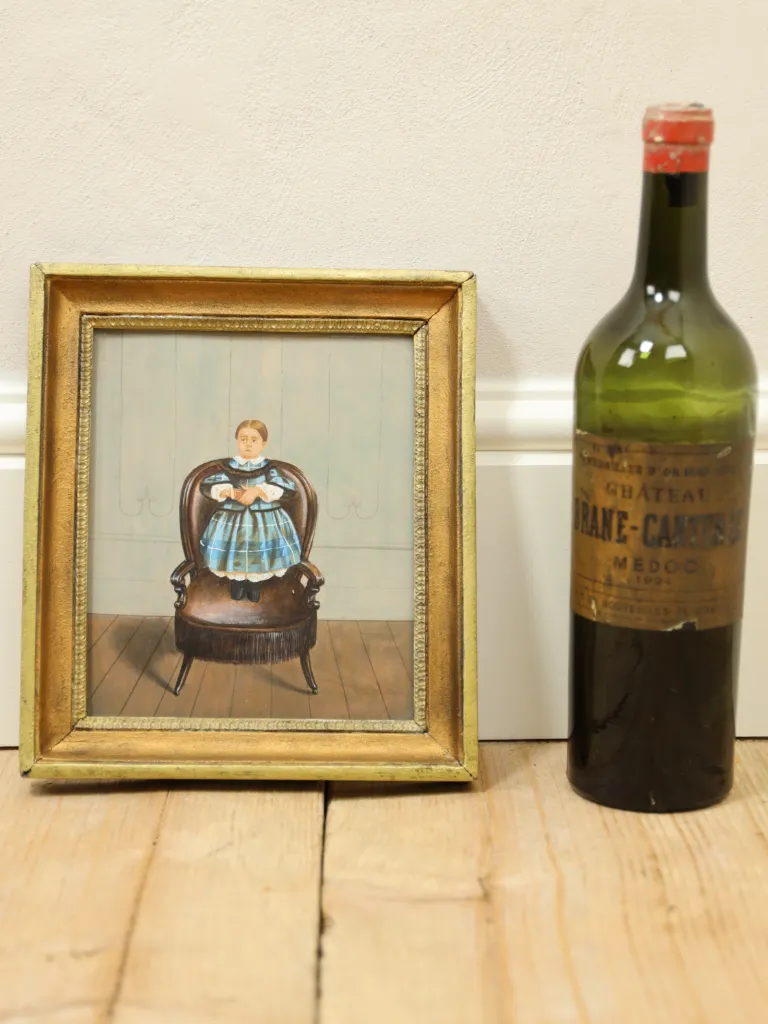
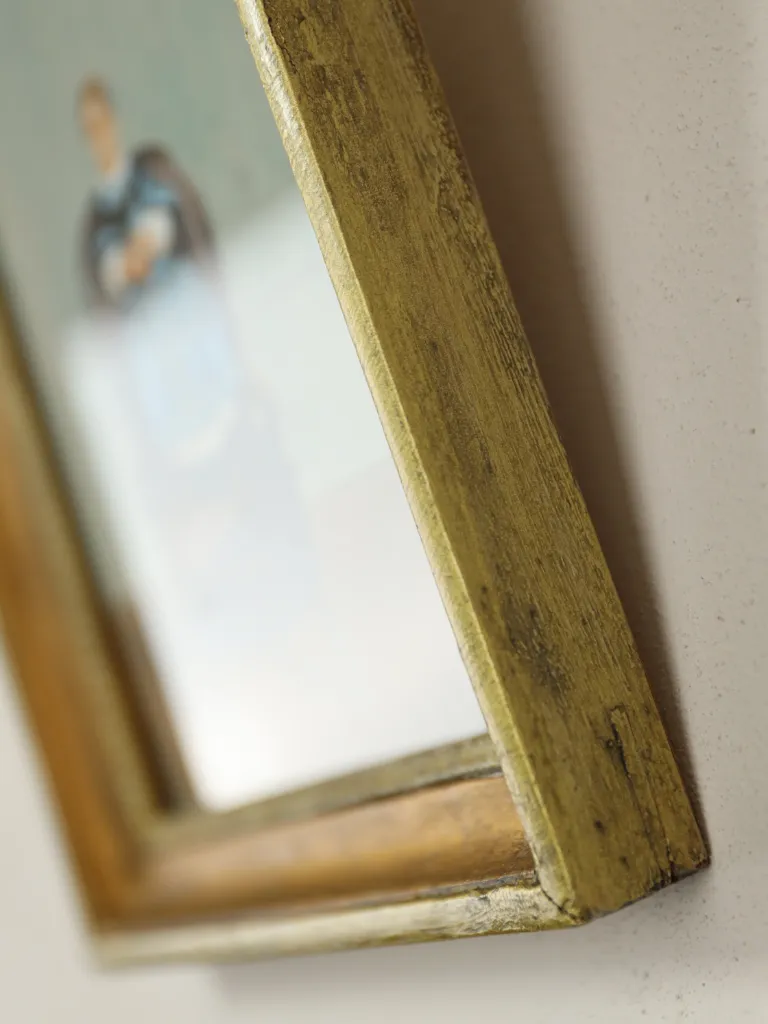
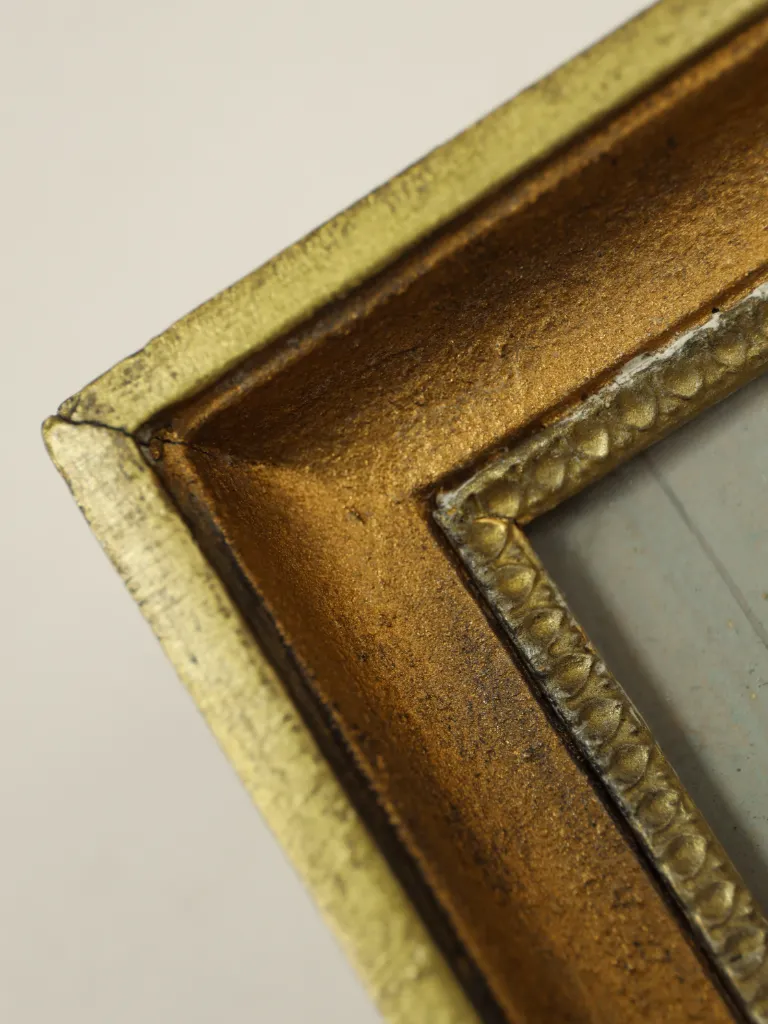
Presented in an antique gilt frame with a broad, restrained profile and finely detailed inner border.
Acquired in Paris, France, remarkably with its family identification still attached to the reverse.
A wonderfully intimate survivor of 19th-century French family life, combining the distinctive charm of naïve portraiture with an unusually personal and partially traceable history.
Presented in good antique condition with the expected signs of age associated with a mid-19th-century work on paper.
There is age-related toning, fading, minor marks and surface imperfections. These characteristics are consistent with the age and nature of the work and contribute to its wonderfully authentic appearance.
The antique gilt frame displays rubbing, marks and wear to the gilded surface commensurate with age.
Importantly, the handwritten family provenance remains attached to the reverse and has been retained as an integral part of the history of the portrait.
Please refer closely to the photographs, which form an important part of the condition description.
Height: 23.5 cm / 9.3 inches
Width: 20.5 cm / 8.1 inches
Depth: 2.5 cm / 1 inch
Weight: 0.4 kg / 0.9 lbs
Every item offered by Shackleton Fox is carefully inspected, prepared, and where necessary conserved within our workshop prior to sale.
As heritage craftsmen and antique specialists, we believe in preserving the authenticity and integrity of each piece. Original finishes, patina, wear, and signs of age are retained wherever possible, as these elements contribute to both character and historical significance.
When restoration, rewiring, repairs, or conservation work is required, it is undertaken sympathetically using traditional techniques and materials appropriate to the period of the piece. Our philosophy is one of careful stewardship rather than unnecessary restoration, ensuring antiques remain both functional and historically respectful.
The result is a collection of pieces that have been thoughtfully prepared, allowing future owners to enjoy them with confidence while preserving their unique story and character.