£2,850.00
A wonderfully decorative and exceptionally substantial pair of late 19th-century Continental European bronze putti, modelled as reclining winged cherubs playing musical instruments.
Beautifully cast and full of character, one putto is depicted playing a long flute while his companion blows a small horn or trumpet. Both figures recline amongst deeply modelled scrolling drapery, their feathered wings extending behind them and their animated poses giving the pair a wonderful sense of movement.


Pair of Late 19th Century Continental Bronze Musical Putti Figures
A wonderfully decorative and exceptionally substantial pair of late 19th-century Continental European bronze putti, modelled as reclining winged cherubs playing musical instruments.
Beautifully cast and full of character, one putto is depicted playing a long flute while his companion blows a small horn or trumpet. Both figures recline amongst deeply modelled scrolling drapery, their feathered wings extending behind them and their animated poses giving the pair a wonderful sense of movement.
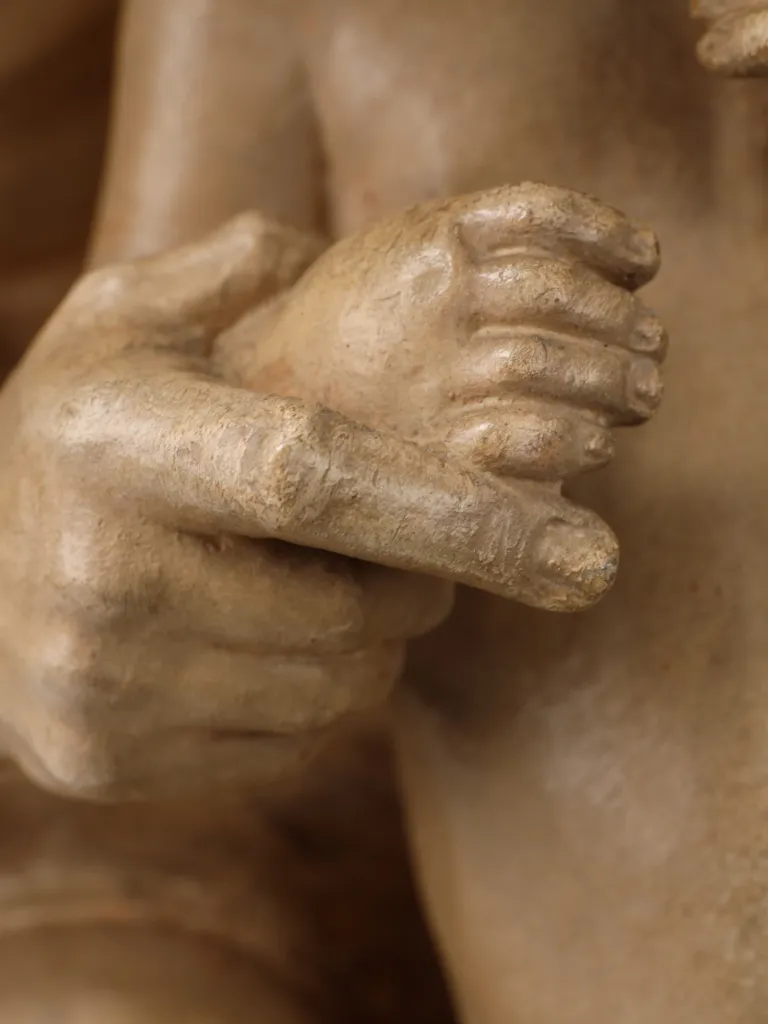
The quality of the modelling is particularly evident throughout. Expressive faces, curling hair, individually defined fingers and toes, detailed wings and the folds of the surrounding drapery have all been carefully rendered. The smooth rounded forms of the figures provide an attractive contrast against the more deeply worked hair, feathers and fabric.
The bronzes retain a rich warm brown patina, with darker tones settling naturally into the recessed areas and gentle variations across the raised surfaces. Small areas of natural wear reveal warmer bronze tones beneath, adding to their established antique character.
Despite their playful subject, these are remarkably substantial objects. Each figure weighs approximately 7.8 kg, giving the pair a combined weight of approximately 15.6 kg / 34.4 lbs.
Importantly, these are freestanding reclining bronzes rather than wall-mounted cherubs. Their composition has been conceived specifically to sit horizontally upon a substantial piece of furniture or architectural surface.
This makes them particularly effective within an interior. Positioned at either end of a long sideboard or console table, the pair can beautifully frame a large statement vase, urn, lamp or piece of sculpture. Their complementary poses naturally create a balanced decorative arrangement.
Equally successful upon a substantial mantelpiece, library bookcase or country-house console, these are unusual and highly decorative late 19th-century bronzes with considerable presence, weight and character.
Putti — the familiar winged infant figures derived from Classical and Renaissance art — became one of the most enduring decorative motifs in European art and interiors.
Closely associated with love, music, abundance and celebration, putti appeared extensively in Italian Renaissance painting and sculpture before becoming an important decorative element of the Baroque and Rococo periods.
Musical putti were particularly popular, their instruments providing both narrative and movement. They appeared throughout European decorative schemes in paintings, architectural ornament, furniture, clocks, lighting and sculpture.
During the 19th century, European artists and bronze founders enthusiastically revisited earlier Renaissance, Baroque and Rococo traditions. Historicist interiors created a renewed demand for decorative bronzes inspired by earlier European art, and the winged putto became an especially popular subject.
This late 19th-century pair, circa 1880–1900, follows that tradition beautifully.
Their reclining composition is particularly interesting. Rather than being conceived as conventional upright statuettes or wall-mounted architectural ornaments, the figures have been modelled for horizontal display.
The musical attributes create a natural relationship between the two bronzes: one playing a flute and the other a horn or trumpet. Displayed together, they form a wonderfully theatrical musical pairing.
Late 19th Century
Circa 1880–1900
Continental European
The modelling and decorative treatment are consistent with Continental European bronze production of the late 19th century.
Unknown
No identifiable sculptor's signature or foundry mark has presently been established.
Cast bronze with a rich brown patinated finish.
The substantial weight of the figures is particularly noteworthy, with each bronze weighing approximately 7.8 kg / 17.2 lbs.
The established brown patination displays natural tonal variation, with warmer bronze highlights visible across areas of raised detail and historic wear.
Private collection.
No additional documentary provenance accompanies the pair.
We absolutely love these and were particularly drawn to them because they are so different from the wall-hanging cherubs and putti that we more commonly encounter.
These were designed to recline naturally upon a horizontal surface, and that makes them incredibly effective decorative objects.
At 7.8 kg each, you immediately appreciate just how substantial they are when handled. Together they weigh more than 15 kg, yet the sculptor has managed to give both figures a wonderful sense of movement and playfulness.
The detailing is lovely too — from their expressive faces and masses of curling hair to their wings, fingers, toes and beautifully modelled drapery.
Our favourite way to display them would be at either end of a long sideboard or console table, with a large statement vase, urn, lamp or piece of sculpture positioned centrally between them. Their opposing musical poses naturally frame the central object and create a wonderfully considered arrangement.
They would look equally impressive across a substantial mantelpiece, upon a large library bookcase or incorporated into a country-house interior.
We also like that despite being unmistakably antique, they don't necessarily require a traditional setting. Against a simpler contemporary interior, the dark bronze and sculptural forms could look particularly striking.
A wonderfully decorative pair with real weight, presence and character — exactly the sort of objects that can completely transform a long console or sideboard.
Presented in very good antique condition consistent with their late 19th-century date.
Both bronzes retain an attractive and well-established warm brown patina, with natural variations in colour and areas of gentle rubbing and surface wear to the raised details.
There are minor marks, scratches and small areas of patina loss visible upon close inspection, entirely consistent with age and previous handling.
In several areas, the natural wear reveals warmer bronze tones beneath the darker patination. We consider this an attractive part of the aged surface rather than something requiring restoration.
The pair have been sympathetically cleaned whilst deliberately retaining their established patina and antique character. They have not been excessively polished or refinished.
Please refer to the detailed photographs, which form an integral part of the condition report.
Height: 42 cm / 16.5 inches
Width: 33 cm / 13 inches
Depth: 20 cm / 7.9 inches
Weight: 7.8 kg / 17.2 lbs
Every item offered by Shackleton Fox is carefully inspected, prepared, and where necessary conserved within our workshop prior to sale.
As heritage craftsmen and antique specialists, we believe in preserving the authenticity and integrity of each piece. Original finishes, patina, wear, and signs of age are retained wherever possible, as these elements contribute to both character and historical significance.
When restoration, rewiring, repairs, or conservation work is required, it is undertaken sympathetically using traditional techniques and materials appropriate to the period of the piece. Our philosophy is one of careful stewardship rather than unnecessary restoration, ensuring antiques remain both functional and historically respectful.
The result is a collection of pieces that have been thoughtfully prepared, allowing future owners to enjoy them with confidence while preserving their unique story and character.