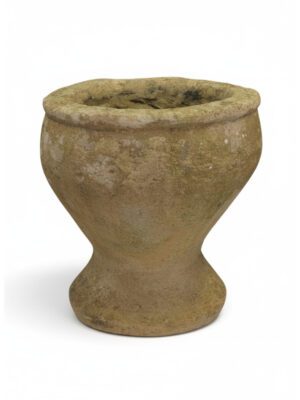
Cast stone is a material made by pouring or tamping a mixture of cement, crushed stone aggregate and sand into moulds, producing architectural components and ornaments that imitate natural carved stone. It is widely used for garden statuary, urns, planters, balustrades, finials, pier caps, sundial pedestals and building details.
Artificial stones have a long history, the most celebrated English example being Coade stone, a fired ceramic material produced in Lambeth from the late eighteenth century, which is technically distinct from cement-based cast stone. Cement-based cast stone developed in the nineteenth century following improvements in Portland cement, and by the late Victorian and Edwardian periods firms were producing garden ornaments and architectural elements in large numbers. Production continued throughout the twentieth century, and many of the garden urns and figures on the market today date from the mid century onwards. Well-made cast stone can be very convincing, but it can usually be identified by its uniform texture, mould lines and the visible aggregate in damaged areas. Collectors value good-quality moulds, crisp detail and an attractive weathered surface with moss and lichen. Older pieces with established patina command higher prices, and cast stone remains a practical, more affordable alternative to carved stone in the garden.