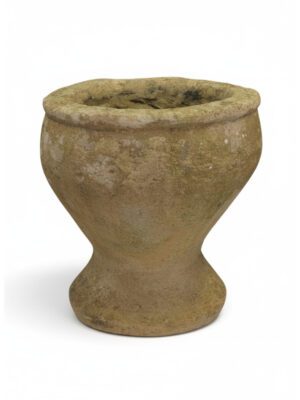
A stone urn is a vase-shaped vessel carved or cast in stone, used as an ornament in gardens and on buildings. Urns may be placed on pedestals, gate piers, balustrades, terraces and parapets, and they can be purely decorative, sometimes with a lid or flame finial, or open for planting.
The form derives from classical antiquity and became a central element of European formal gardens from the Renaissance onwards. In eighteenth-century England, landscape gardeners and architects placed urns along walks, at the end of vistas and on the rooflines of Palladian houses. Popular shapes include the campana, or inverted bell, and versions of the Medici and Borghese vases, often decorated with gadrooning, masks, swags or handles. Urns were carved from limestone, sandstone and marble, and from the late eighteenth century were also produced in artificial stones such as Coade stone, while later cast and reconstituted stone versions were made in large numbers. Collectors value good proportions, crisp carving, weathered surfaces with moss and lichen, and matching pairs. Frost damage, cracks and replaced bases should be checked, and an urn used for planting needs drainage to protect it.