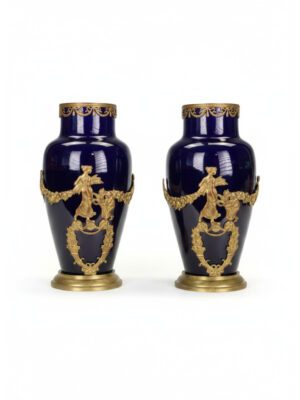
Art Nouveau pottery is ceramic ware made in the Art Nouveau style from about 1890 to the start of the First World War, distinguished by flowing organic lines, sinuous plant and flower forms, and richly coloured or iridescent glazes. Vases, jardinières, tiles, figures and tablewares were all produced in the style.
On the Continent, French potters such as Clément and Delphin Massier developed lustre glazes, while factories in Austria and Bohemia, notably Amphora, made elaborately modelled vases. The Dutch Rozenburg factory produced eggshell-thin painted wares, and the Secession movement inspired more geometric designs in Vienna. In Britain the style often appeared in a gentler form, with William Moorcroft's Florian ware for James Macintyre, Minton's Secessionist range and the work of art potteries such as Burmantofts and Della Robbia. Tube-lining, in which raised lines of slip outline the design, was a characteristic technique. Collectors look for strong design, quality of glaze, clear marks and good condition, and the best pieces display beautifully in period interiors or as a contrast in a plain modern room.