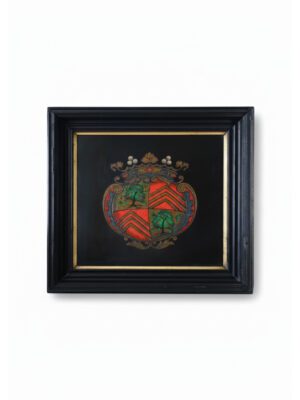
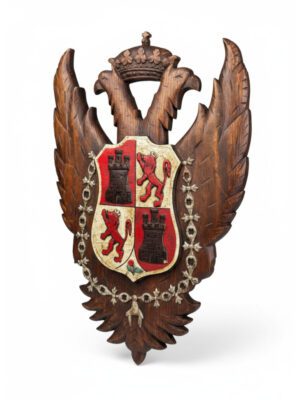
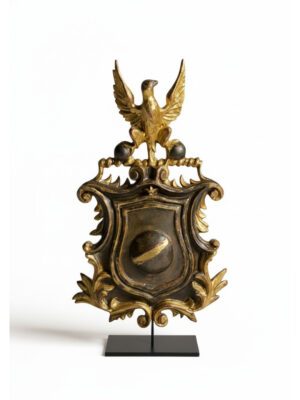
A coat of arms is a heraldic design belonging to an individual, family, institution or town, displayed on a shield and often accompanied by a crest, helmet, mantling, supporters and a motto. In Britain, the use of arms is regulated by the College of Arms in England and the Court of the Lord Lyon in Scotland.
Coats of arms developed in medieval Europe as a means of identification in battle and tournament, and became symbols of lineage and status. They have long been applied to objects of every kind, including silver, porcelain, glass, furniture, bookplates, textiles, fireplaces, stained glass and architecture. Wealthy families commissioned Chinese armorial porcelain services in the eighteenth century, engraved arms or crests on their silver and carved them into chimneypieces and over doorways. For collectors and historians, a coat of arms can be invaluable, since identifying the family can establish provenance, date and the circumstances of a commission, which may add significantly to value. Erased or later-added arms, by contrast, should be viewed with caution. Heraldic panels, carved and painted achievements and armorial objects remain popular decoration in halls and libraries.