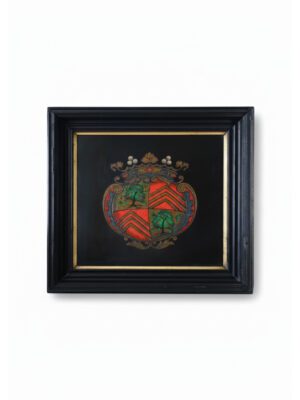
Heraldry is the system of identifying individuals, families and institutions by hereditary coats of arms, and the art and rules governing how those arms are designed, described and displayed. A full achievement of arms may include a shield, crest, helm, mantling, supporters and motto, each described in a precise technical language known as blazon, using terms such as gules for red, azure for blue and or for gold.
Heraldry emerged in Europe in the twelfth century, when knights in armour needed recognisable devices on shields and banners, and soon became a mark of lineage and status. In England, the granting of arms is overseen by the College of Arms, founded in the fifteenth century. Coats of arms and crests appear across the decorative arts: engraved on silver, painted on Chinese armorial porcelain made to order for European families, carved on furniture and chimneypieces, set into stained glass, woven into textiles and cast into firebacks and hatchments. For collectors and dealers, heraldry is a valuable research tool, since an identifiable coat of arms or crest can link an object to a particular family or house and strengthen its provenance. Care is needed, however, as arms were sometimes added later, and crests were often shared by several families of the same name.