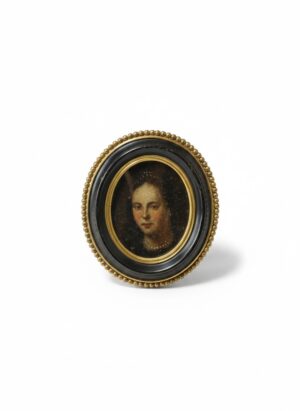
A portrait miniature is a small painted portrait, usually no more than a few inches high, made to be held in the hand, worn as jewellery or kept in a case. The term derives from the Latin minium, the red lead used in illuminated manuscripts, rather than from the small size of the works.
The art developed in the sixteenth century from manuscript illumination, and England produced some of its greatest exponents, notably Nicholas Hilliard and Isaac Oliver at the Elizabethan and Jacobean courts, and Samuel Cooper in the seventeenth century. Early miniatures were painted in watercolour on vellum laid on card, while from the early eighteenth century ivory became the usual support, giving a luminous quality to the flesh tones. Enamel miniatures were also produced. The late Georgian period was a golden age, with artists such as Richard Cosway and John Smart. Miniatures were exchanged as tokens of love, mourning and friendship, often in gold or gilt frames with hair or initials on the reverse. Collectors consider the artist, the sitter, the quality of painting and condition. Miniatures on ivory are subject to trade and export regulations, which should be checked before buying or selling.