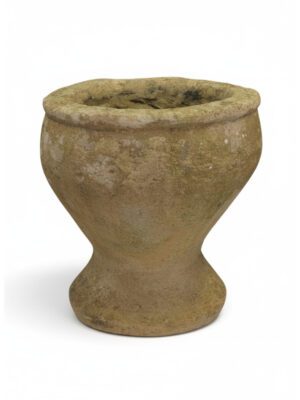
Coade stone is a type of high-fired ceramic stoneware made to imitate carved stone, produced at Lambeth in London from the late eighteenth to the early nineteenth century. Its original name was Lithodipyra, meaning stone fired twice, and it was moulded from a clay body mixed with grog, flint, quartz and crushed glass.
The material is named after Eleanor Coade, who took over an artificial stone business in Lambeth in 1769 and ran it with great success until her death in 1821, at a time when women rarely controlled industrial firms. Her cousin John Sealy was a partner from 1799 to 1813, during which the firm traded as Coade and Sealy, and William Croggon continued the business after her death until his bankruptcy in the 1830s. Leading sculptors provided models, and the factory supplied statues, coats of arms, keystones, capitals, urns, fountains, monuments and garden ornaments to architects such as Robert Adam and John Nash. Coade stone is renowned for its exceptional resistance to weathering, and pieces often survive with crisp detail where stone has eroded. Many are stamped with the Coade name and sometimes a date, which is a key aid to authentication.