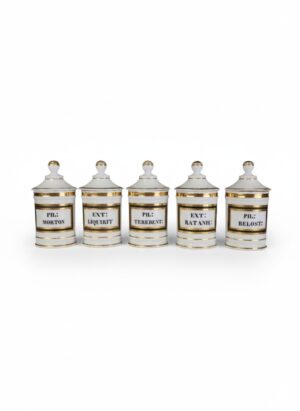
An apothecary jar is a container made to hold the herbs, powders, ointments, syrups and other ingredients kept by apothecaries and pharmacists. Jars were made in tin-glazed earthenware, porcelain, stoneware and glass, and were often labelled, painted or gilded with the name of their contents, usually in abbreviated Latin, so that they could be identified on the shop shelves.
Among the earliest and most admired forms is the albarello, a waisted cylindrical jar made in Italian maiolica and in Spain from the fifteenth century onwards. In England, delftware drug jars of the seventeenth and eighteenth centuries, painted in blue with cartouches, cherubs and birds, are especially sought after, as are wet drug jars with spouts for syrups and oils. The nineteenth century brought glass shop rounds with gilt or enamelled labels, large carboys and display jars, and printed or painted ceramic jars in sets. Collectors look for early date, good painting, legible and interesting inscriptions, original lids where applicable and sound condition, accepting some glaze loss on early earthenware. Apothecary jars are popular in kitchens, bathrooms and libraries, both as display pieces and for practical storage, and a run of matching jars makes a striking arrangement on open shelving.