French Empire is the grand neoclassical style associated with the rule of Napoleon I, who was crowned emperor in 1804, and it remained fashionable until around 1815 and, in diluted form, for some years after. Developed largely by the architects Charles Percier and Pierre Fontaine, it was intended to express imperial power and drew directly on the art of ancient Rome, Greece and Egypt.
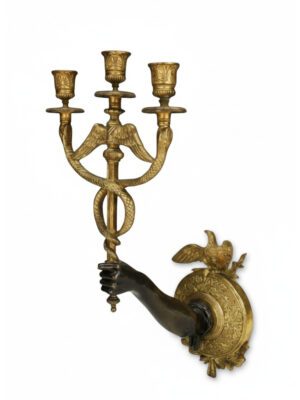
Empire furniture is massive, symmetrical and architectural, usually made of mahogany veneers, with flat surfaces enriched by finely chased and gilded bronze mounts. Typical motifs include laurel wreaths, eagles, bees, swans, stars, winged victories, lion masks and the letter N, while Egyptian sphinxes and lotus forms reflect the interest stirred by Napoleon's Egyptian campaign. Characteristic forms include the gondola chair, the bateau or sleigh bed, the console table with columnar supports, the guéridon and the psyché mirror. The cabinetmaker François-Honoré-Georges Jacob-Desmalter was among the leading makers. The style spread across Europe and influenced British Regency taste. Collectors look for quality and originality of the mounts, the figure of the mahogany and evidence of a good Parisian workshop, as later copies are common.