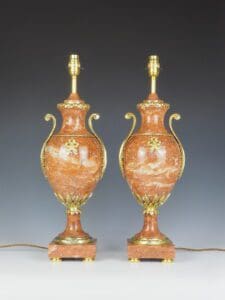














A French garden urn is an ornamental vase or planter made for a garden, terrace or courtyard in the French classical manner. Urns of this kind are usually raised on a pedestal or plinth and take the form of a campana, shaped like an inverted bell, or a baluster or Medici vase, often with gadrooned bodies, egg-and-dart rims, masks or handles.
Urns were an essential part of the formal French garden, whose axial vistas, parterres and terraces were punctuated by vases and statues, as at Versailles in the late seventeenth century. Grand gardens used marble and bronze, but the nineteenth century brought cast iron urns produced in great quantities by French foundries, which supplied parks, villas and town gardens across Europe and beyond. Cast iron urns were usually painted, and many have been repainted several times. Terracotta, stone and composition stone versions were also made. Collectors look for crisp casting, original or early paint, foundry marks on iron examples and a matching base, as urns and plinths are often separated over time. Cracks, rust damage and frost damage should be checked carefully. A pair of French urns flanking a doorway, steps or gate gives an instant sense of architecture and formality, and they work equally well planted or left empty.






