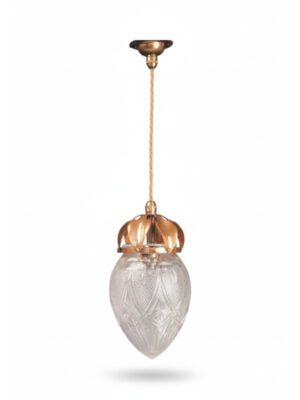
A gilt bronze chandelier is a hanging light fitting with a frame of cast bronze finished with a thin layer of gold, a material often called ormolu. Gilding protected the metal from tarnishing and gave a warm, rich glow, and many gilt bronze chandeliers also incorporate cut-glass drops, crystal pendants, coloured glass or porcelain flowers.
Gilt bronze lighting reached its height in France in the eighteenth and early nineteenth centuries, where skilled founders, chasers and gilders produced chandeliers in the Louis XV, Louis XVI and Empire styles, with scrolling arms, foliage, classical figures and laurel or acanthus ornament. Before the mid-nineteenth century, the gold was usually applied by mercury gilding, a hazardous process that produced an especially durable finish, while later pieces were generally electrogilded. Revivals of earlier French styles were made in large numbers in the late nineteenth century, many of very high quality. Collectors look for crisp, finely chased casting, original gilding that has not been overcleaned or replaced with lacquer, and complete glass elements. Most period examples have been converted from candles to electricity. A gilt bronze chandelier makes a striking centrepiece in a drawing room, dining room or grand entrance hall.