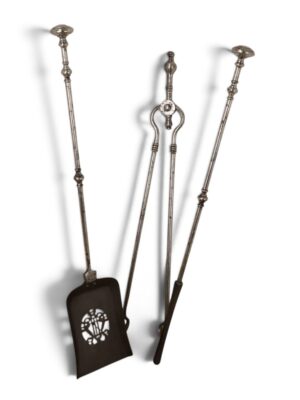
A poker is a metal rod used to stir and rearrange burning fuel in an open fire, grate or stove, encouraging it to draw and burn evenly. It forms one of the principal fire irons, usually sold together with tongs and a shovel, and sometimes a brush, as a set placed beside the hearth.
Pokers have been made for centuries by blacksmiths in wrought iron, but the most decorative examples date from the Georgian and Victorian periods, when polished steel and brass were used with finely turned, faceted or cast handles. Regency fire irons often have elegant steel shafts with urn or ball finials, while Victorian and Edwardian sets display Gothic, Arts and Crafts or Art Nouveau designs in brass, copper and iron. Companion sets on a stand became common in the later nineteenth century, while earlier irons were usually propped against rests on the fender or grate. Collectors look for good proportions, original finishes, crisp detail on the handle and matching sets that have stayed together. Antique pokers remain practical everyday tools, and their quality of manufacture usually far exceeds that of modern equivalents.