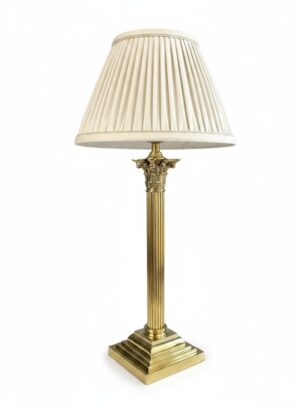
Edwardian lighting refers to light fittings made in Britain during the reign of Edward VII from 1901 to 1910, and more loosely up to the First World War. It was a period of transition, as electricity spread rapidly through wealthier homes and public buildings, while gas and oil lighting remained common elsewhere.
Edwardian fittings are often lighter and more elegant than their Victorian predecessors. Typical designs include brass and bronze ceiling pendants and electroliers with multiple arms, wall brackets, rise-and-fall lights, and table lamps with fluted columns, often fitted with shades of etched, frosted, vaseline, opaline or coloured glass. Neoclassical and Sheraton Revival motifs such as swags, urns and ribbons were popular, alongside the flowing lines of Art Nouveau and the simpler forms of Arts and Crafts makers such as W.A.S. Benson. Many Edwardian fittings were designed for early electric bulbs and adapt well to modern use once rewired. Their scale and refinement make them particularly suitable for period houses and contemporary interiors alike.