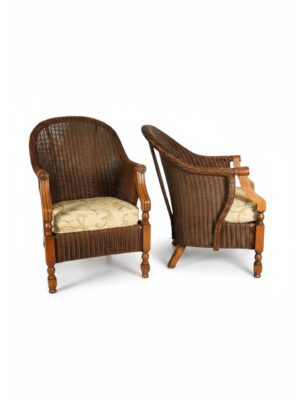
Lloyd Loom is a type of woven furniture made from twisted kraft paper wound around a wire core, which is woven on a loom into sheets and fitted over a bentwood frame. It resembles wicker or cane but is smoother, more uniform and less prone to splintering and creaking.
The process was invented by the American Marshall Burns Lloyd, who patented it in 1917 and supplied furniture to the American market. In 1922 the British firm W. Lusty and Sons acquired the licence to produce Lloyd Loom furniture in Britain, and the company made hundreds of thousands of pieces over the following decades, including tub chairs, armchairs, sofas, linen baskets, dressing tables, bedroom chairs and tables. The furniture was popular in hotels, ocean liners, tea rooms and family homes, and was usually painted in colours such as gold, blue, green, cream or brown, often with a sprayed or brushed finish. Genuine Lusty pieces frequently carry a label or a metal tag with a date, which collectors look for. Original paint, sound weave and a strong frame are important, and the furniture remains popular in bedrooms, bathrooms and conservatories today.