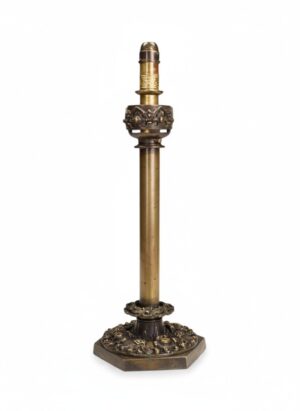
A brass candlestick is a holder for a single candle made of brass, an alloy of copper and zinc. Brass was the most common material for domestic candlesticks in Britain and Europe for centuries, being cheaper than silver and more durable than pewter or wood.
Early medieval candlesticks often used a pricket, a spike on which the candle was impaled, but socketed candlesticks became usual from the later medieval period. Seventeenth-century English and Dutch examples frequently have a wide drip pan midway down the stem, while eighteenth-century candlesticks show baluster and knopped stems cast in two halves and joined vertically, with an ejector rod or slot for removing candle stubs. Victorian makers in Birmingham produced brass candlesticks on an industrial scale, often with a push-up mechanism. Collectors judge age by construction, the colour of the alloy, the seam, the base and evidence of wear. Many later reproductions copy early designs, so knowledge of casting methods is useful. Antique brass candlesticks remain popular for dining tables and mantelpieces, and they should be cleaned gently to avoid removing the soft patina built up over years.