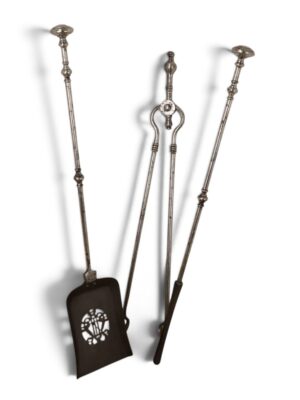
Tongs are a hinged or sprung gripping tool with two arms, used for picking up and moving objects that should not be handled directly. In the antiques world the term most often refers to fire tongs for placing coal or logs on the hearth, but it also covers sugar tongs, asparagus tongs and other small implements for the table.
Fire tongs were a standard part of the fireside set alongside the poker and shovel, and examples survive from the seventeenth century onwards in wrought iron, steel, brass and combinations of these metals. Georgian and Regency steel tongs often have finely turned or polished handles, while Victorian sets are frequently in cast brass with decorative finials. Long log tongs were made for the large open hearths of country houses. Silver sugar tongs, first made as scissor-action nips in the eighteenth century and later as one-piece sprung bows, are a popular collecting field, since they are hallmarked and can be dated precisely. When buying fire tongs, collectors look for good balance, sound hinges, matching companion pieces and original finishes, while silver examples are judged on their marks, gauge and decoration.