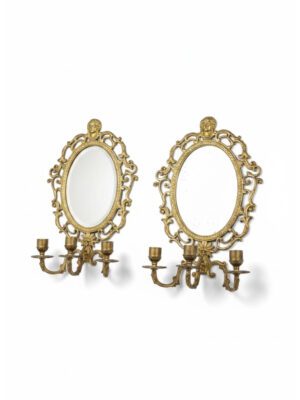
A bevelled mirror is a mirror whose glass has been ground and polished at an angle around its edges, creating a sloping border that catches and refracts the light. The bevel softens the edge of the glass and gives a mirror an added sense of quality and depth.
Bevelling was done by hand from the late seventeenth century, when English mirror plates were made at Vauxhall and elsewhere, and early bevels are typically very shallow and wide, sometimes barely visible, following the line of the frame. Victorian and Edwardian mirrors more often have a deeper, sharper machine-cut bevel, which became standard on overmantel, dressing and wardrobe mirrors. Venetian and Venetian-style mirrors use bevelled and engraved glass panels in complex frames. When assessing an antique mirror, the character of the bevel helps to date the glass, and a shallow hand-ground bevel with slight irregularities is a good sign of an early plate. Original glass may show foxing or loss of silvering, which many buyers prefer to keep as evidence of age rather than replace with modern glass.