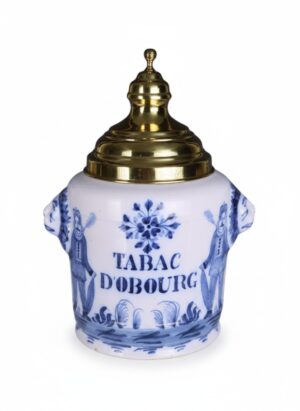
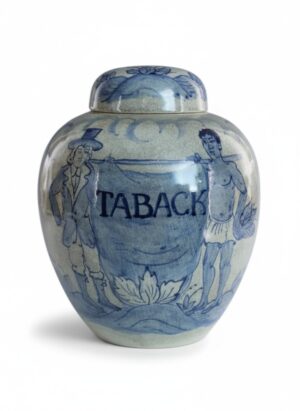
Delftware is tin-glazed earthenware, a buff or reddish pottery body covered with an opaque white glaze made with tin oxide and painted with colours, most often cobalt blue. The name comes from the Dutch town of Delft, which became the leading centre of production in the seventeenth century, and in Britain the lower-case term delftware is used for pottery made in the same way in England and Ireland.
Dutch potters sought to imitate the costly Chinese blue and white porcelain being imported by the Dutch East India Company, producing vases, garnitures, plates, tiles and flower holders in great quantity. In England, tin-glazed pottery was made in London, notably at Lambeth and Southwark, and at Bristol, Liverpool and elsewhere from the late sixteenth to the late eighteenth century. English wares include chargers with blue-dash borders, posset pots, drug jars, plates, punch bowls and tiles. Because the soft body chips easily, wear and flaking to rims are almost universal and generally accepted by collectors, though restoration should be noted. Value depends on age, rarity of form and decoration, inscriptions and dates, and the quality of the painting. Factory marks on Dutch pieces are often copied.