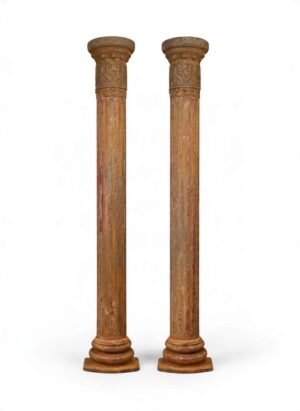
An entablature is the horizontal superstructure that rests on the columns or pilasters of a classical building. It is made up of three parts, read from the bottom upwards: the architrave, a plain or stepped beam spanning the columns; the frieze, a central band that may be left plain or carved with ornament; and the cornice, the projecting moulded crown that throws rainwater clear of the wall beneath. The proportions and details of each part vary according to the order, whether Doric, Ionic or Corinthian.
The entablature developed in the temple architecture of ancient Greece and was codified by the Romans, then revived in Renaissance Italy and transmitted to Britain through pattern books and the Palladian movement. It became a defining element of Georgian and Neo-Classical design, both on the outside of buildings and inside them, where it appears as cornices, door cases and overmantels. Its influence on the decorative arts is wide: bookcases and cabinets are often crowned with a full entablature, chimneypieces and pier mirrors frequently carry a frieze and cornice, and Regency furniture borrows its mouldings. Recognising a correctly proportioned entablature is a useful sign of a well-designed piece by a maker who understood classical architecture.