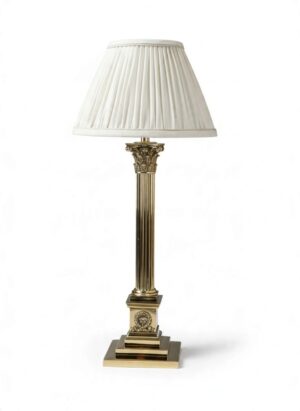
An abacus, in architecture, is the flat slab forming the uppermost part of a column capital, on which the architrave of the entablature rests. It provides a broad, level bearing surface between the capital and the beam above, and its form varies according to the classical order.
In the Greek Doric order the abacus is a plain, square block set above the rounded echinus. In the Ionic order it is thinner and often moulded, sitting above the volutes, while in the Corinthian and Composite orders it typically has concave sides with the corners cut off or projecting above the acanthus foliage. Romanesque and Gothic builders also used abaci, often square or octagonal and sometimes decorated with mouldings. Understanding the abacus helps collectors and architectural historians identify the style and period of columns, capitals and architectural fragments, as well as furniture and lighting based on classical models, such as column lamps and pedestals. The word also describes the traditional counting frame of beads on wires, which may occasionally be encountered as a collectable object, but in architectural antiques the term almost always refers to the top of a capital.