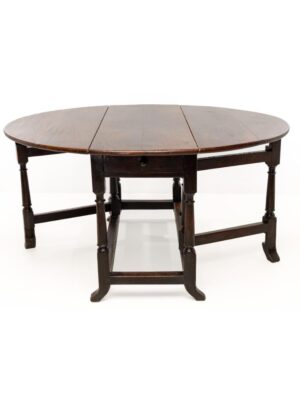
A folding card table is a table made for playing cards whose top is hinged so that it folds in half when not in use. Closed, it stands against a wall or between windows as a neat side table; opened, the top is supported by one or more legs that swing out on a gate action or by a concertina frame, revealing a playing surface usually lined with baize or fine woollen cloth. Some later examples have a top that swivels a quarter turn on the frame before unfolding, so that the opened leaf rests on the base below.
Card playing was a passion of fashionable society in the eighteenth century, and card tables became standard furniture in the drawing rooms of the Georgian period. Early examples in walnut and mahogany often have dished corners for candlesticks and sunken wells for counters, while Regency tables favour rosewood and satinwood, crossbanding and brass inlay, often raised on a central pedestal. Victorian card tables were made in large numbers, frequently in burr walnut with serpentine tops. Collectors look for original cloth or sympathetic replacement, sound hinges, an unwarped top and matching colour on the inner and outer surfaces. Card tables were frequently made in pairs, and a matched pair is especially desirable.