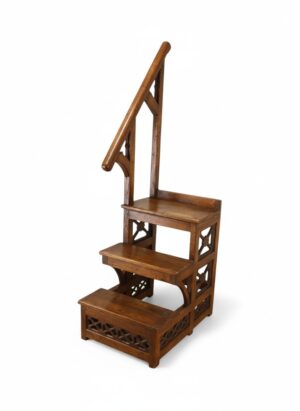
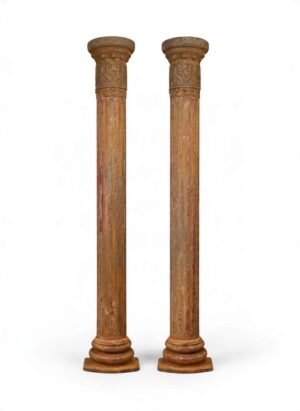
A handrail is a rail fixed alongside a staircase, landing, balcony or ramp to give people something to hold for support and to prevent falls. On a traditional staircase it is carried on balusters, also known as banisters, which rise from the treads or a string, and it is anchored at the bottom and at turns by newel posts.
In English houses of the sixteenth and seventeenth centuries, staircases with heavy oak handrails, robust turned or carved balusters and massive newels were often among the most richly decorated features of a house. During the eighteenth century, handrails became lighter and more elegant, with mahogany increasingly used for its strength and smooth finish, and staircases were often designed with continuous ramped and wreathed rails ending in a spiral volute over a cluster of slender balusters. Wrought-iron and later cast-iron balustrades, usually topped with a mahogany or brass rail, became fashionable from the later Georgian period and were widely used in Victorian houses. Original handrails show skilled joinery, particularly in the curved sections, and develop a deep patina from generations of hands. Salvaged rails, newels and balusters are sought for restoration, and original staircases are often protected as part of listed buildings, so alterations should respect their historic character.