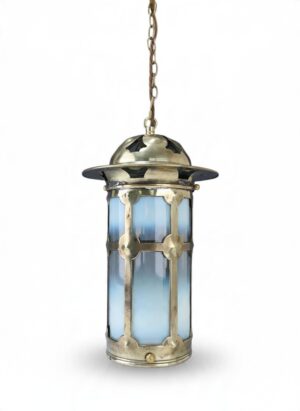
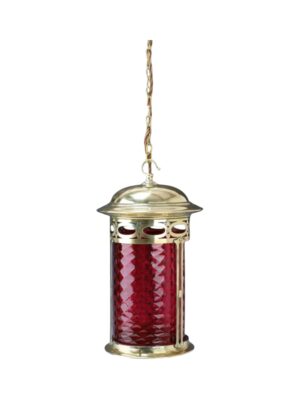
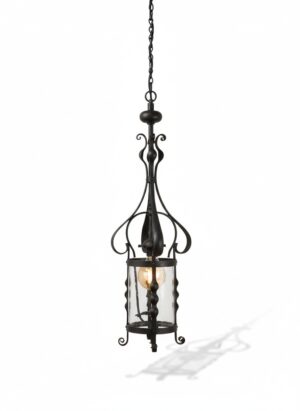
A hanging lantern is a light suspended from a ceiling, in which the light source is enclosed within a framework of metal and glass. Originally designed to protect a candle flame from draughts, lanterns were especially suited to entrance halls, staircases, porches and passages, where doors opening and closing would otherwise blow out the light.
In Britain, hall lanterns were a feature of fine Georgian houses, often made in gilt brass or carved giltwood with glazed panels, a smoke cowl above and a candle holder within, and they were suspended on chains or rods. Typical shapes include square, hexagonal, octagonal and cylindrical forms, the latter often called tubular or bell lanterns, sometimes with a bowl-shaped glass. Victorian and Edwardian examples were made in brass, copper, bronze and wrought iron, for oil, gas and eventually electricity, with etched, coloured, bevelled or leaded glass and pierced galleries. Collectors look for good proportions, original glass, quality castings and attractive original surfaces. Most antique lanterns found today have been converted to electricity, and any example intended for use should be rewired and tested by a qualified electrician. A well-chosen lantern remains one of the most effective ways to light a period hall or staircase, giving warm light and an immediate sense of architectural character.