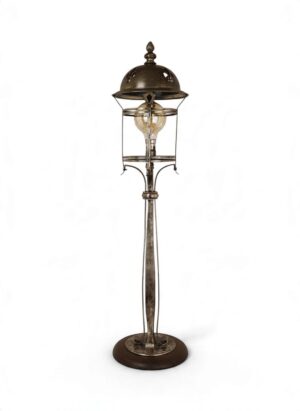
A rise and fall light is a ceiling pendant whose height can be adjusted by pulling the fitting up or down, the position being held by a counterweight, a pulley system or a spring-loaded reel. It allows the light to be lowered over a table or work surface when needed and raised out of the way at other times.
Adjustable hanging lamps were used for oil lighting in the Victorian period, particularly over dining and billiard tables and in kitchens, offices and libraries, and telescopic gas pendants offered a similar facility. With the spread of electric lighting in the late nineteenth and early twentieth centuries, rise and fall fittings became very popular, usually with a brass or ceramic counterweight, a twin flex running over pulleys and a glass or enamelled shade. Examples range from simple industrial fittings to ornate Edwardian brass pendants with cut or etched glass shades. Collectors look for complete mechanisms, original weights and ceiling roses, and shades of the correct period and fitting size. Old flex and wiring must always be replaced and tested by a qualified electrician before use, as the moving cable is subject to wear.