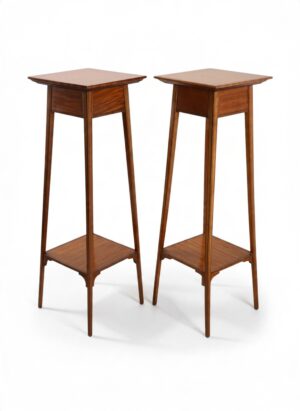
Thomas Sheraton (1751–1806) was an English furniture designer and author whose name is given to the elegant, light neoclassical furniture fashionable in Britain around the 1790s and early 1800s. Born in Stockton-on-Tees, he trained as a cabinetmaker but is not known to have run a workshop in London, where he worked as a drawing master and writer.
His reputation rests on his publications, above all The Cabinet-Maker and Upholsterer's Drawing-Book, issued in parts from 1791, followed by the Cabinet Dictionary of 1803. These offered designs for chairs, tables, sideboards, bookcases, dressing tables and ingenious mechanical furniture, characterised by slender square or turned tapering legs, straight lines, delicate inlay, painted decoration and the use of satinwood and other exotic veneers. Because no furniture can be attributed to Sheraton's own hand, the term Sheraton describes a style drawn from his designs and those of his contemporaries, not a maker. Pieces of the period in this manner are prized for their refinement, quality of veneers and inlay, and good proportions, and they are frequently confused with later Sheraton Revival work. Sheraton-style furniture is light enough to suit smaller rooms and modern homes.