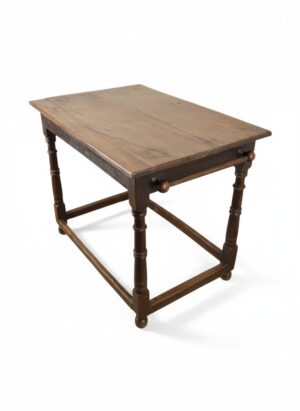
A Sutherland table is a small drop-leaf table with an unusually narrow fixed centre and two deep hinged leaves, each supported when raised by a swing-out gateleg. When the leaves are lowered the table folds to a slim profile and can stand against a wall taking up very little room, yet when opened it provides a generous surface for tea, cards or sewing.
The table is traditionally said to be named after Harriet, Duchess of Sutherland, a prominent figure at the court of Queen Victoria, and the form became popular from the mid nineteenth century. Victorian examples were made in mahogany, walnut and rosewood, often with turned or spiral-twist legs and supports, while Edwardian versions were frequently produced in satinwood or mahogany with inlaid or painted decoration and slender tapering legs. Some have shaped, serpentine or oval leaves. Sutherland tables suit modern living well, making practical occasional or side tables in small rooms, flats and cottages. Buyers should check that the hinges and gatelegs operate smoothly, that the leaves are original and not warped, and that the veneers and figure on the surface are in good condition.