
£595.00
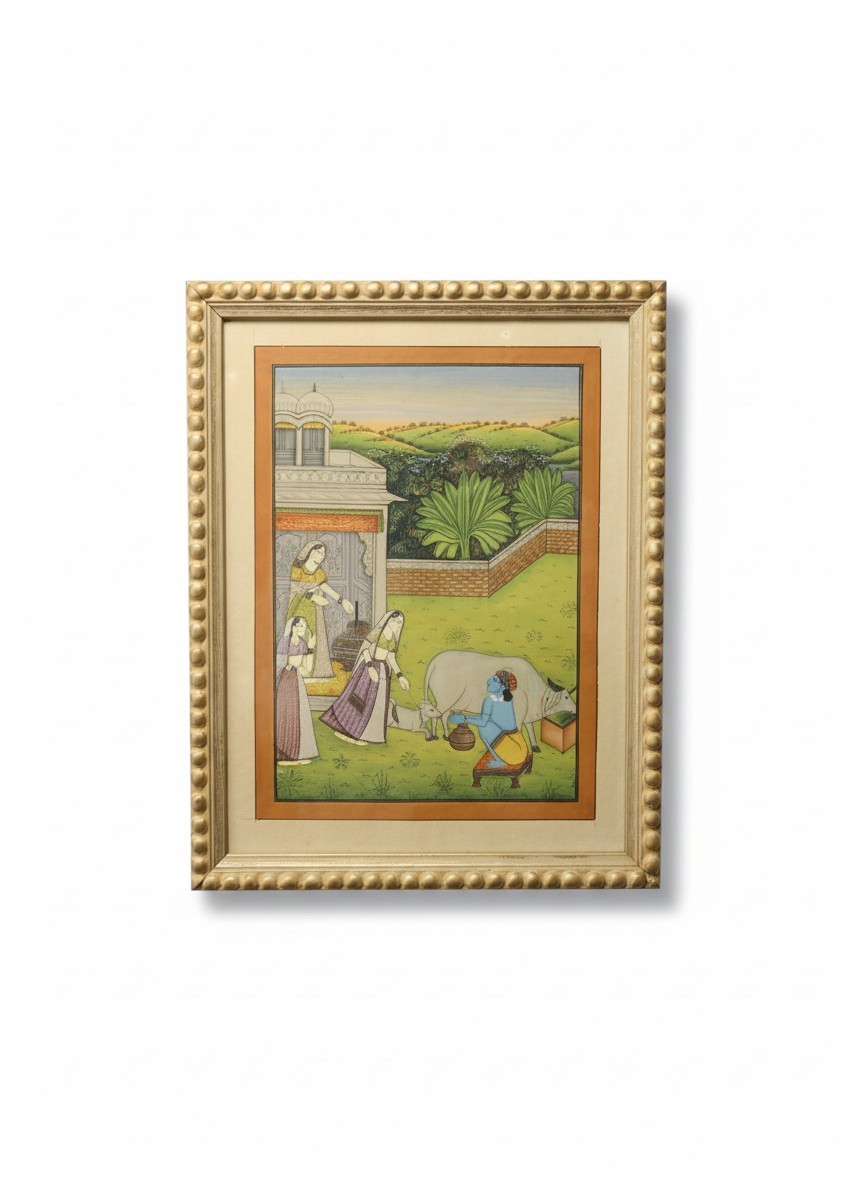
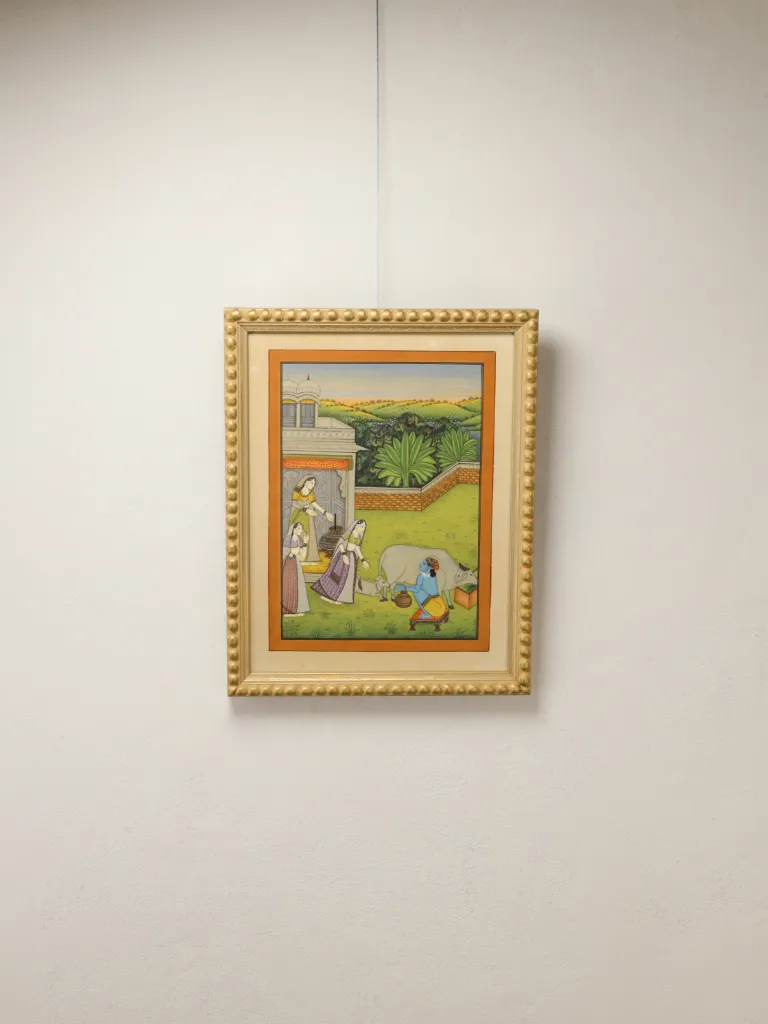
A beautifully detailed Indian miniature painting depicting Krishna milking a sacred cow accompanied by gopis, set within an elegant palace garden and verdant pastoral landscape.



A beautifully detailed Indian miniature painting depicting Krishna milking a sacred cow accompanied by gopis, set within an elegant palace garden and verdant pastoral landscape.
Executed in opaque watercolour and ink on paper, the painting follows the long-established North Indian tradition of devotional painting centred upon the life of Krishna. The composition is particularly charming, combining finely observed figures, animals, architecture and landscape within a richly coloured and meticulously detailed scene.
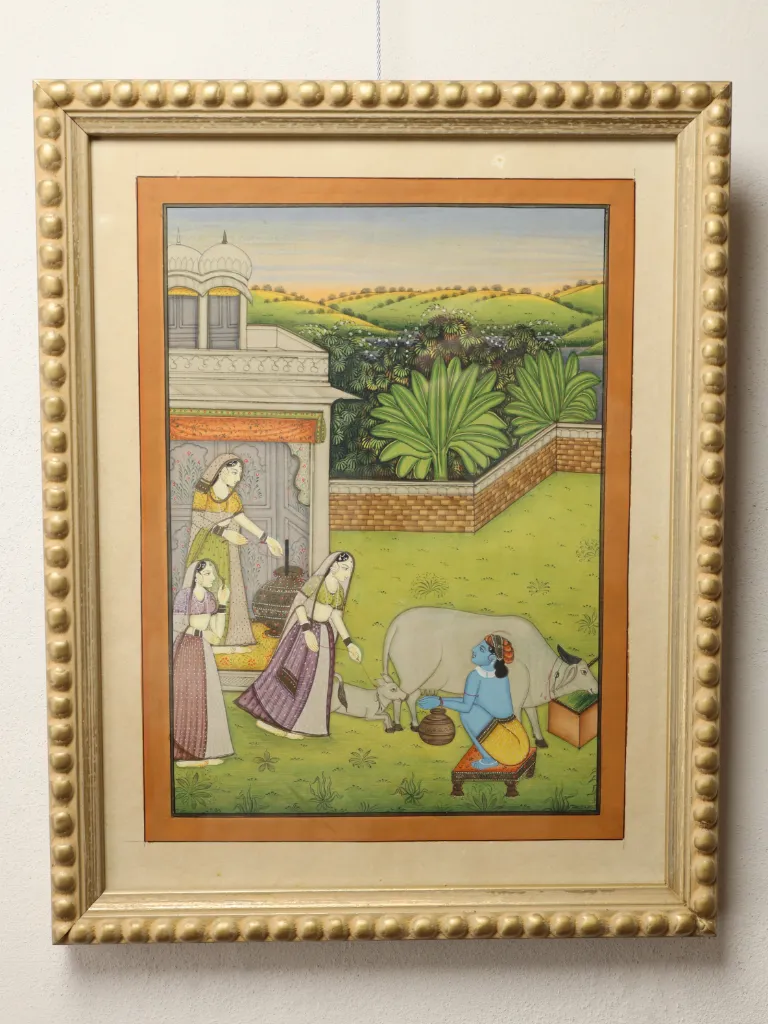
Krishna, immediately recognisable by his distinctive blue skin, is seated on a low decorated stool beside a large white cow, milking into an earthenware vessel. A calf rests close to its mother, while three elegantly dressed female figures emerge from the palace to the left.
The painting has been newly framed and glazed, presented within a decorative gilt frame chosen to complement the warm colours and traditional character of the work.
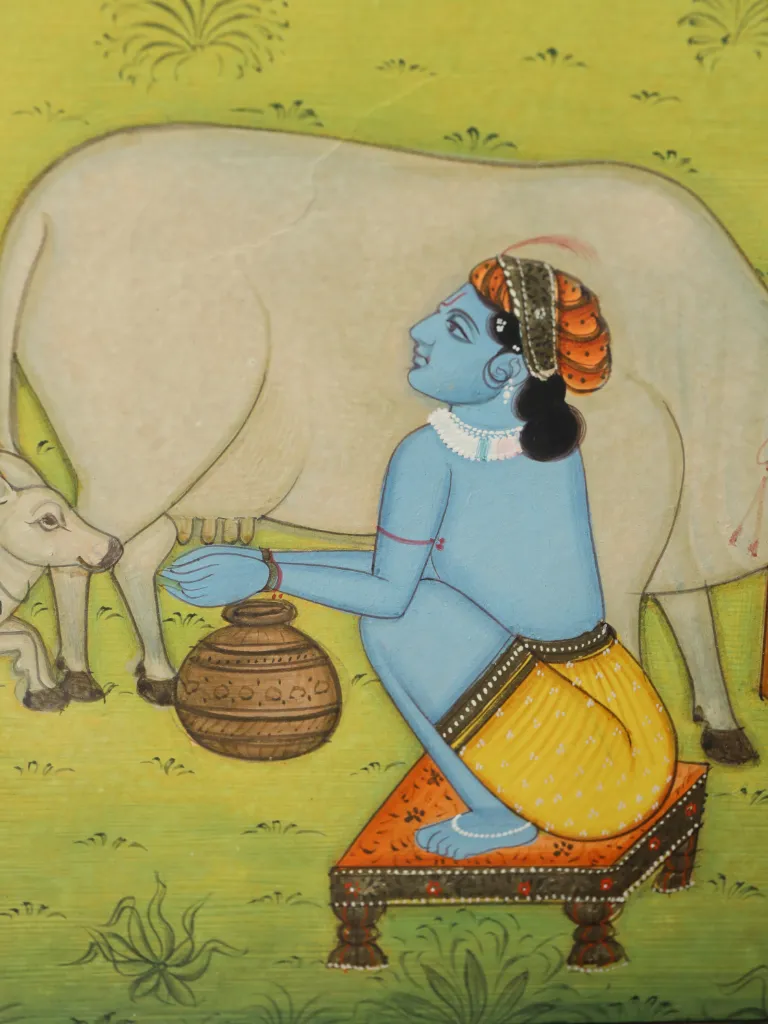
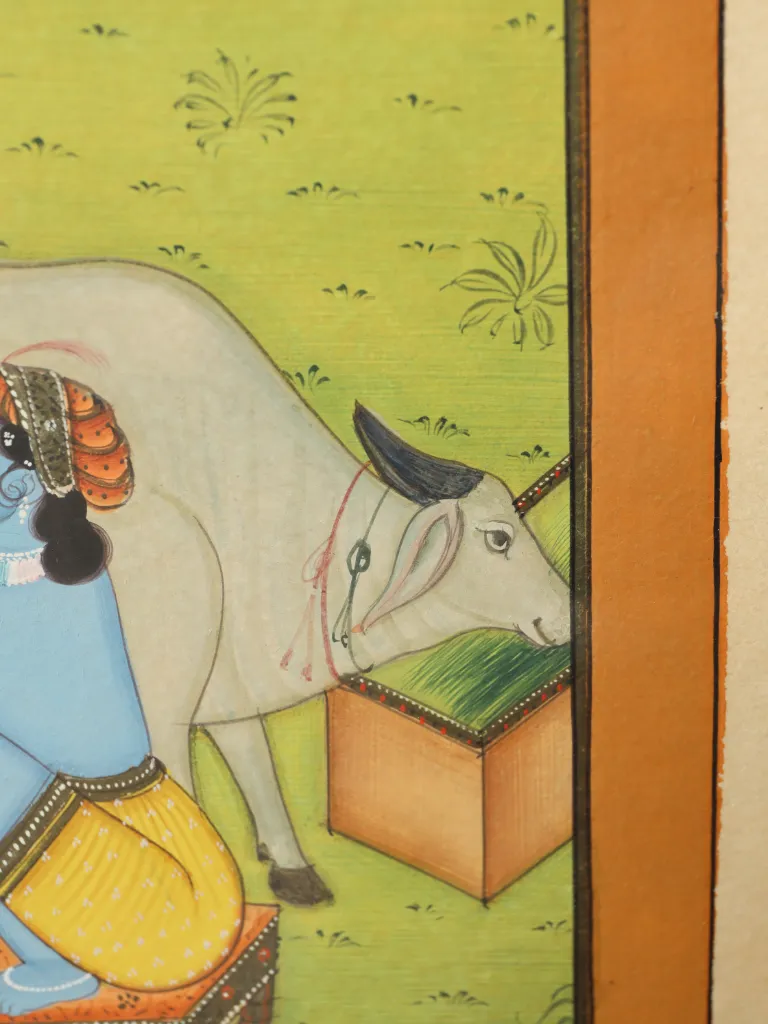
Krishna occupies the lower right of the composition, his brilliant blue skin creating a striking contrast against the pale body of the cow and vivid green garden.
He is shown seated on a low orange and dark-painted stool, dressed in a bright yellow dhoti and wearing an elaborate orange headdress, jewellery and a pearl-like necklace.
One hand reaches beneath the cow towards an earthenware vessel, depicting the everyday pastoral activity of milking.
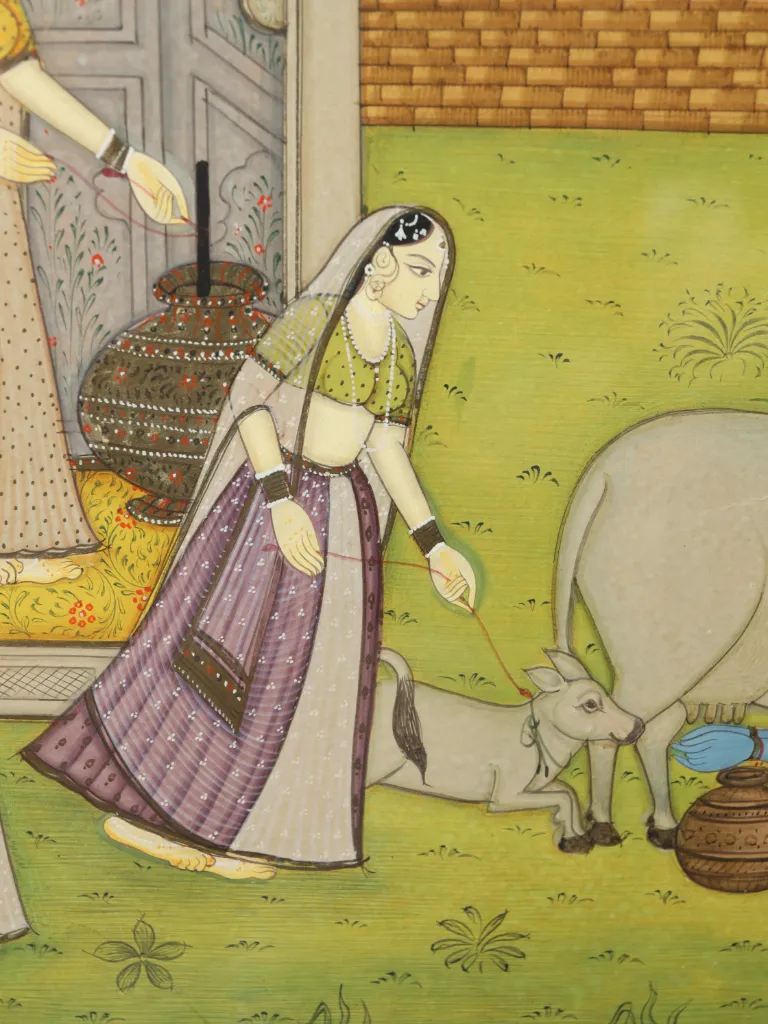
The cow dominates the central section of the composition, accompanied by a resting calf. Its pale colouring provides a calm visual centre around which the remaining figures have been arranged.
Krishna's role as a cowherd and his association with cattle form an important part of his traditional iconography and became a recurring subject within Indian miniature painting.
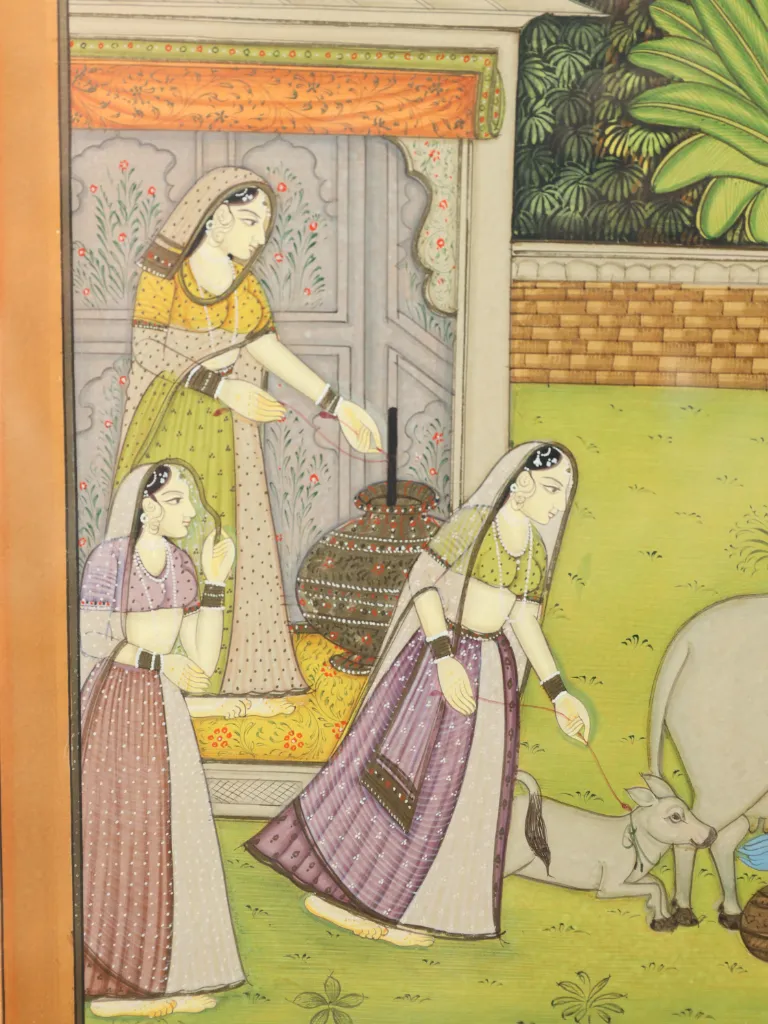
Three elegantly dressed women emerge from the palace on the left of the composition.
The figures are depicted wearing finely detailed traditional clothing in shades of yellow, green, mauve, pink and cream, embellished with minute painted decoration.
Transparent veils fall across their hair and shoulders, while necklaces, earrings, bangles and other jewellery are picked out with exceptionally fine brushwork.
The leading figure reaches towards the calf, linking the group visually with the pastoral scene occupied by Krishna.
These female figures are represented in the tradition of the gopis — the cowherd women closely associated with Krishna's life and devotional imagery.
The setting adds considerably to the decorative quality of the painting.
At the left stands an elegant palace pavilion with finely drawn architectural details and delicate floral decoration. Above it rises a small domed pavilion, while painted textiles and patterned architectural surfaces introduce further colour and detail.
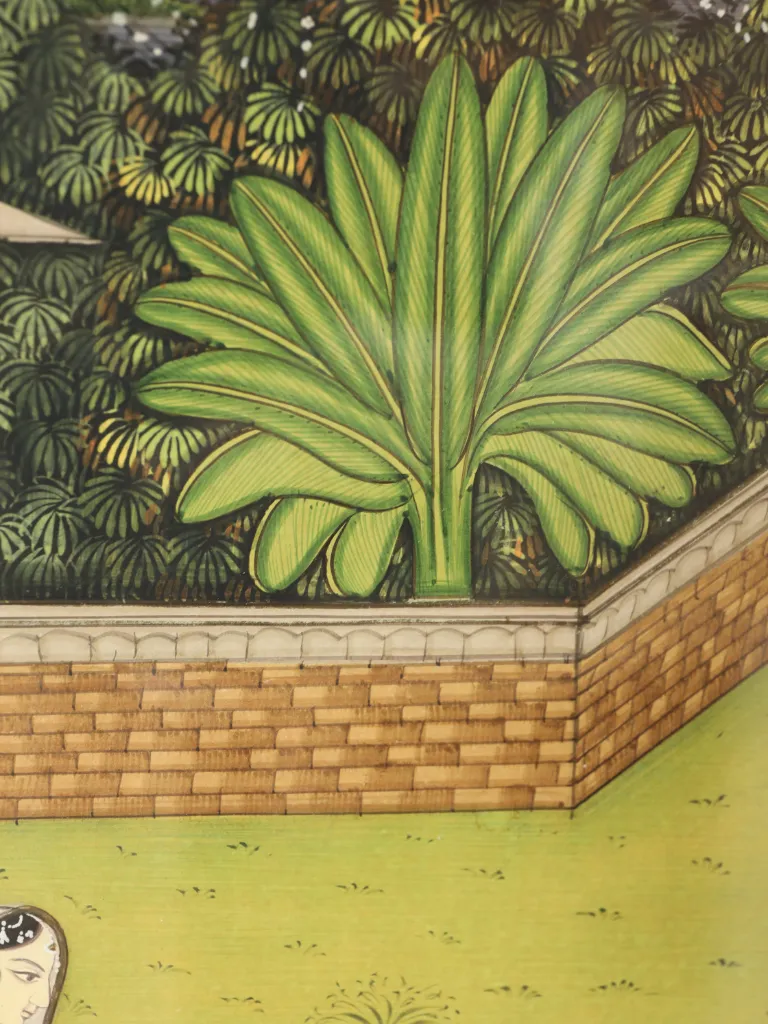
The immediate foreground opens into a vivid green enclosed garden bordered by brickwork and lush tropical planting.
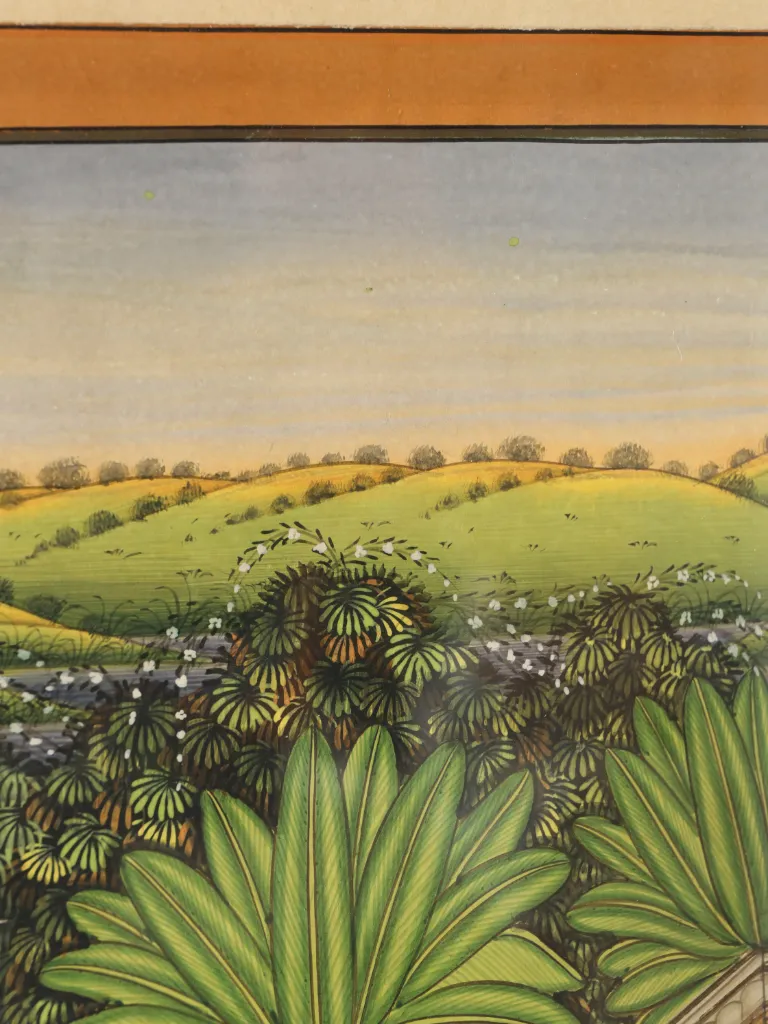
Beyond the garden, the composition extends into a distant landscape of rolling green hills, scattered trees and a softly graduated sky, creating a sense of depth beyond the formal palace enclosure.
Large stylised leaves and dense vegetation provide a strong decorative backdrop to the figures and architecture.
The work follows the traditions of North Indian Rajput miniature painting, particularly the colourful devotional imagery produced in Rajasthan.
Rajput painters frequently depicted episodes from Krishna's life, combining religious narrative with courtly architecture, gardens, animals and idealised landscapes.
The precise linear drawing, flattened perspective, saturated colour, carefully patterned textiles and strongly defined figures seen here all draw upon this established artistic tradition.
The painting is unsigned and has no documented attribution to a particular historic workshop or regional school. It is therefore catalogued as a 20th-century Indian Rajput-style miniature painting, attributed to Rajasthan, rather than assigned to a specific school or named artist.
The composition has been executed in opaque watercolour and ink on paper.
Fine dark outlines define the figures, animals, architecture and vegetation, while layers of colour create the richly decorative surface.
Particularly impressive is the minute detailing throughout the composition. Individual strands and patterns within the women's clothing, jewellery, facial features, architectural decoration, foliage and furnishings have all been carefully articulated.
Delicate white highlights appear throughout the costumes and jewellery, contrasting against the stronger areas of yellow, mauve, orange, green and blue.
The principal image is enclosed within fine ruled borders and a broad terracotta-orange painted surround, characteristic of the presentation of Indian miniature paintings.
The painting has been newly framed and glazed, providing a finished presentation ready for display.
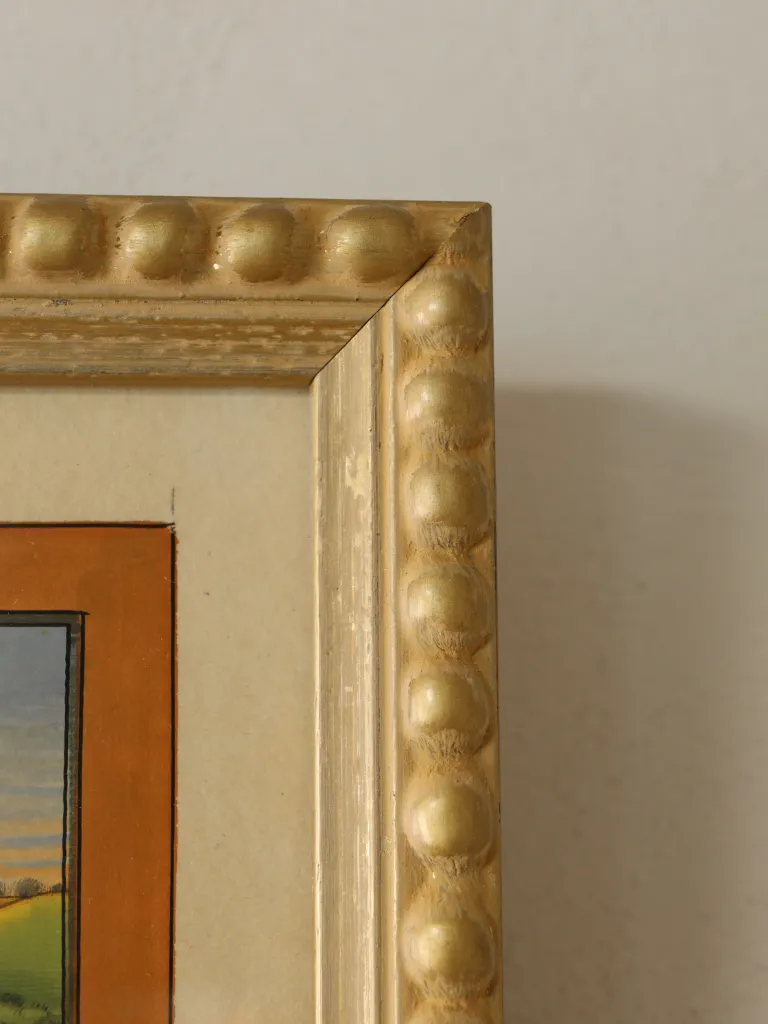
A traditional neutral mount surrounds the painted border, allowing the strong colours of the miniature to remain the principal focus.
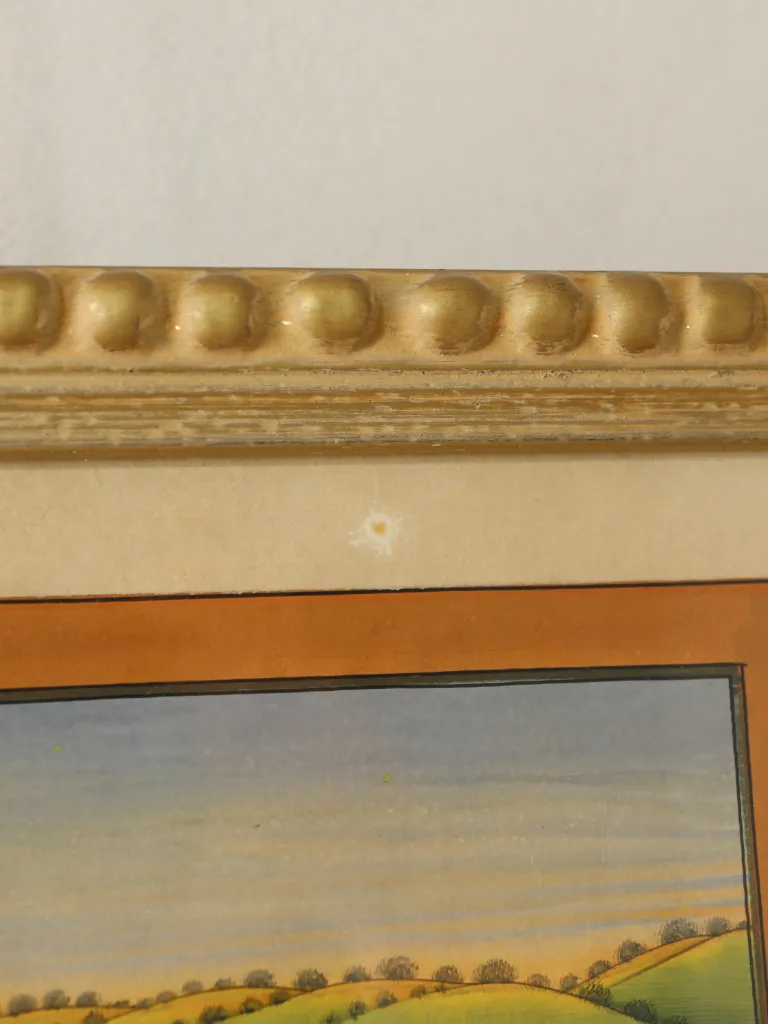
The decorative gilt frame features a pronounced raised bead border surrounding a stepped inner moulding. Its softly antiqued gold finish complements the terracotta, yellow and green tones within the painting without overwhelming the delicacy of the artwork.
The traditional framing also allows the work to sit comfortably alongside European paintings, antique works on paper and collected objects within a layered country-house interior.
Presented in good decorative condition.
The painting displays minor age-related variations and marks consistent with its materials and history.
The work has been newly mounted, glazed and framed, providing protection for the painted surface and allowing it to be displayed immediately.
Please refer closely to the detailed photographs, which form an integral part of the condition report.
A particularly attractive example of Indian decorative miniature painting, combining an immediately recognisable Krishna subject with beautifully observed figures, animals and architecture.
The strong greens of the garden and distant landscape are balanced by the softer tones of the palace architecture and the vibrant yellow, mauve and orange of the figures' clothing.
Its relatively compact scale makes it particularly versatile for display, whether incorporated into a collection of works on paper and paintings or used individually to introduce colour and cultural interest to a room.
The combination of Krishna, gopis, sacred cattle, palace architecture and landscape gives the composition both decorative appeal and strong narrative interest.
Height: 33.5 cm / 13.2 inches
Width: 26.5 cm / 10.4 inches
Depth: 2 cm / 0.8 inches
Weight: 0.7 kg / 1.5 lbs
Every item offered by Shackleton Fox is carefully inspected, prepared, and where necessary conserved within our workshop prior to sale.
As heritage craftsmen and antique specialists, we believe in preserving the authenticity and integrity of each piece. Original finishes, patina, wear, and signs of age are retained wherever possible, as these elements contribute to both character and historical significance.
When restoration, rewiring, repairs, or conservation work is required, it is undertaken sympathetically using traditional techniques and materials appropriate to the period of the piece. Our philosophy is one of careful stewardship rather than unnecessary restoration, ensuring antiques remain both functional and historically respectful.
The result is a collection of pieces that have been thoughtfully prepared, allowing future owners to enjoy them with confidence while preserving their unique story and character.