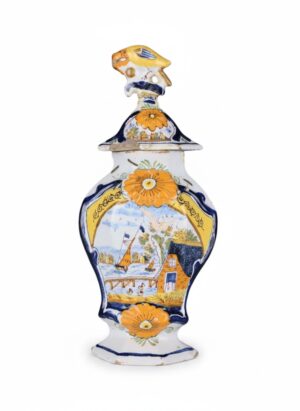
Tin-glazed pottery is earthenware coated with a lead glaze made opaque and white by the addition of tin oxide, providing a smooth pale surface for painted decoration. The technique allowed potters to imitate the appearance of Chinese porcelain long before true porcelain could be made in Europe, and it is known by different names according to its place of origin.
The method spread from the Islamic world to Spain, where lustred Hispano-Moresque wares were made, and then to Italy, where it is called maiolica. In France and Germany it is known as faience, in the Netherlands as Delft, and in Britain as delftware, produced in London, Bristol, Liverpool and Glasgow from the seventeenth to the later eighteenth century. Typical forms include chargers, drug jars, posset pots, tiles, plates and punch bowls painted in high-temperature colours, especially cobalt blue. Because the glaze is fairly soft, chipping around rims and edges is common and is generally accepted by collectors, though extensive restoration reduces value. Dated, inscribed and armorial pieces are particularly prized, and good painting, a well-fitting glaze and a pleasing palette mark the best examples.