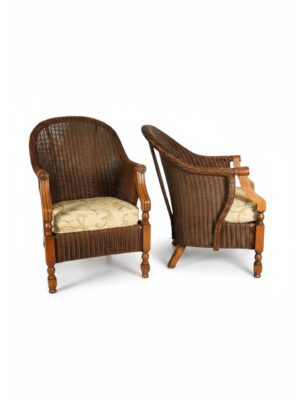
A sabre leg is a furniture leg that curves outwards in a gentle concave sweep, resembling the curved blade of a cavalry sabre. It is most commonly found on chairs, where both the front and back legs may splay outwards, or just the back legs with turned or square tapering front legs.
The form was inspired by the klismos chair of ancient Greece, known from vase paintings and sculpture, and was revived during the Neoclassical and Grecian revival at the end of the eighteenth century. It became one of the most characteristic features of English Regency furniture between about 1800 and 1830, encouraged by designers such as Thomas Hope and Thomas Sheraton and by the fashion for military imagery during the Napoleonic Wars. Sabre legs appear on dining chairs, library chairs, sofas and stools, made in mahogany, rosewood, beech painted to simulate exotic woods, and occasionally brass-inlaid. The curve gives elegance but places strain on joints, so collectors should check for breaks, splices and later repairs, especially where the back leg meets the seat rail. Sets of Regency sabre leg chairs in original condition are particularly desirable.