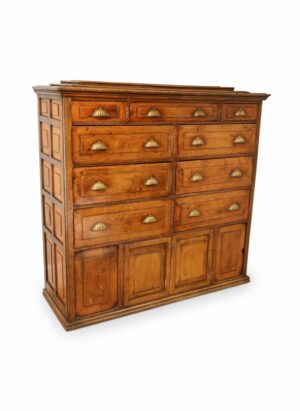
A bachelor's chest is a small, compact chest of drawers whose top folds over and opens out to provide an extended surface, supported on pull-out lopers at the front. When opened, the top can be used for writing, dressing or laying out clothes, while the drawers below provide storage, making it ideal where space was limited.
The form originated in England in the early eighteenth century, and the finest examples date from about 1715 to 1740 and are veneered in figured walnut with crossbanding, feather banding and brass handles and escutcheons, standing on bracket feet. Mahogany examples followed later in the Georgian period. A typical example has two short drawers above two or three graduated long drawers and is narrower than a standard chest. The name is a later term rather than one used at the time, and it is not certain that such chests were intended specifically for unmarried gentlemen. Genuine early examples are rare and valuable, and many apparent bachelor's chests are later conversions or reproductions. Collectors examine the hinges, the lopers, carcase construction and the veneers for signs of alteration and look for original handles, good colour and patina. They are ideal in bedrooms, studies and smaller rooms.