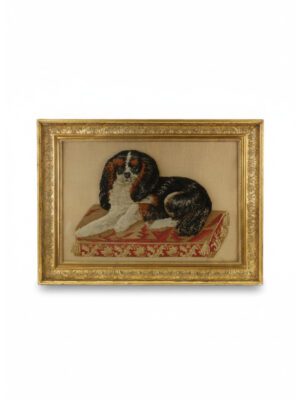
Canvas work is a form of embroidery in which the stitches are worked over the threads of an evenly woven canvas ground, covering it completely. It is often loosely called tapestry, although true tapestry is woven on a loom, and it is also known as needlepoint, particularly in America.
Common stitches include tent stitch, cross stitch and Florentine or Bargello stitch, which produces characteristic flame-like zigzag patterns. Canvas work was used in England from the sixteenth century for cushions, table carpets, bed hangings, chair seats and wall panels, and in the eighteenth century it was a favourite pursuit of genteel women, who worked chair covers and fire screens in wool and silk. The nineteenth century saw a huge vogue for Berlin wool work, a form of canvas work using brightly dyed wools and printed charts imported from Germany, applied to cushions, slippers, pictures, footstools and upholstery. Collectors look for fine stitching, good original colour, attractive designs and well-preserved condition, as wool fades and suffers from moth. Early canvas work upholstery on walnut and mahogany chairs is especially valued, while Victorian panels are popular for cushions, framed pictures and screens in traditional interiors.