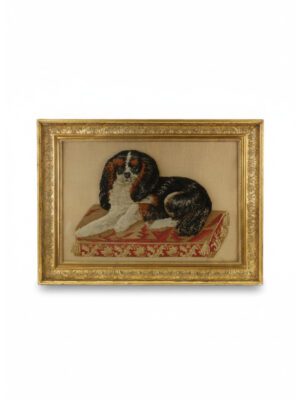
Berlin wool work is a type of canvas embroidery worked in brightly coloured wool, usually in tent stitch or cross stitch, following printed and hand-coloured charts on squared paper. It was the most popular form of amateur needlework in Britain during the mid-nineteenth century.
The technique takes its name from the Berlin publishers who produced the charts from the early nineteenth century, along with the soft merino wools dyed in strong colours that were exported to accompany them. By the 1830s and 1840s the fashion had swept through British households, and Victorian women worked cushions, pictures, bell pulls, slippers, fire screens, footstools and chair seats. Typical subjects include flowers, parrots, dogs, biblical scenes, copies of popular paintings and geometric borders, sometimes enriched with glass beads or raised plush stitches. The introduction of aniline dyes from the late 1850s produced even brighter colours. Collectors look for good design, unusual subjects, strong original colour and sound condition, as wool is vulnerable to moth and fading. Framed panels and upholstered pieces bring warmth and Victorian character to period interiors.