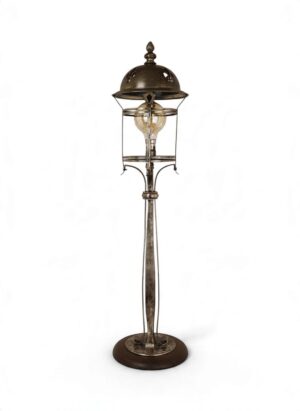
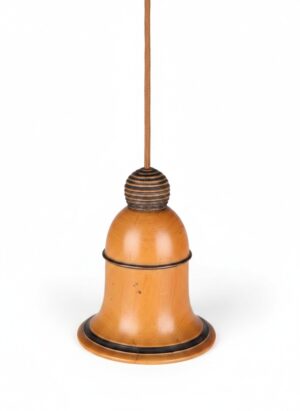
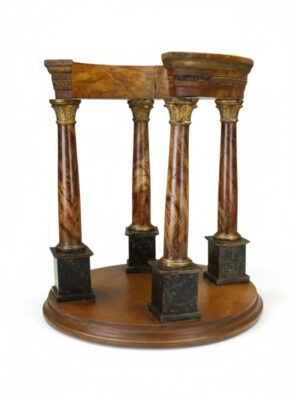
A dome is a rounded vault forming a roof or ceiling over a circular, square or polygonal space, typically hemispherical but also found in shallow saucer, pointed or onion-shaped forms. Domes are often raised on a circular wall called a drum, and may be crowned by a small open or glazed structure called a lantern, which admits light into the space below.
Domes were used in ancient Rome, most famously at the Pantheon, and became central to Byzantine, Islamic and Renaissance architecture, from Hagia Sophia to Brunelleschi's dome for Florence Cathedral. In Britain the dome is closely associated with Sir Christopher Wren's St Paul's Cathedral, and it was adopted for country houses, mausoleums, garden temples and public buildings in the Palladian and Neoclassical styles. Inside houses, shallow domes and domed skylights were used to light stairwells and halls, often decorated with coffering or plasterwork. The form also influenced the decorative arts: domed tops appear on clocks, caddies and furniture, while domed lanterns, ceiling lights and glass domes for displaying clocks, wax flowers or stuffed birds were popular in the Victorian period. Garden domes and domed structures such as gazebos and bandstands also became fashionable. Salvaged architectural domes and cupolas are collected as garden features and focal points.