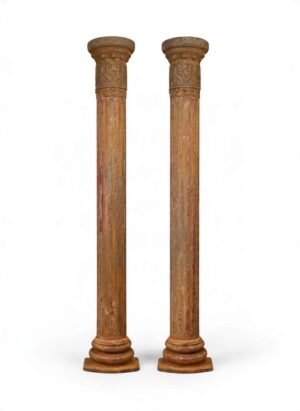
The Doric order is the earliest and simplest of the three principal orders of ancient Greek architecture, the others being the Ionic and Corinthian. An order is a complete system of column and entablature with fixed proportions and details, and the Doric is characterised by sturdy fluted columns, plain cushion-like capitals, and a frieze divided into triglyphs, blocks with vertical grooves, alternating with square panels called metopes, which were often carved with relief sculpture.
The Doric order developed in mainland Greece and the Greek colonies of southern Italy and Sicily, and is seen at its most refined in the Parthenon. The Romans developed their own version, more slender and usually with a base, and added the Tuscan and Composite orders to make five orders in all, as later set out in Renaissance treatises. In Britain the Doric was used in Palladian and Georgian buildings, and the Greek Doric became central to the Greek Revival in the late eighteenth and early nineteenth centuries. Its sense of strength and restraint led architects to use it for ground floors, porticos and masculine interiors such as halls and libraries. The order also shaped furniture, fireplaces and silver, where triglyph friezes and Doric columns provide a crisp, architectural character.