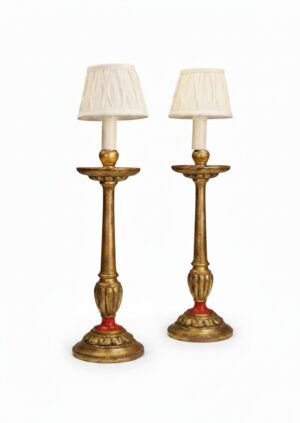
A Georgian candlestick is a candlestick made in Britain during the Georgian period, broadly from 1714 to 1830. They were produced in silver, Sheffield plate, brass, paktong and bronze, as well as in glass and ceramics, and range from tall table candlesticks made in pairs or sets to small chamber sticks with a handle for carrying a light to bed.
Styles changed considerably over the period. Early Georgian candlesticks were usually cast, with octagonal or shaped bases and baluster stems, followed by more elaborate Rococo designs with shell corners and scrolling decoration in the mid-eighteenth century. From the 1760s and 1770s Neoclassical candlesticks adopted Corinthian columns, urn-shaped sconces, beading and festoons, often made in loaded or filled silver from sheet metal in Sheffield and Birmingham. Brass candlesticks followed similar fashions and were widely used in middle-class homes. Detachable nozzles, or drip pans, became common as the century progressed. Collectors look for matching pairs, clear hallmarks on silver, original nozzles, crisp casting and an absence of splits, dents or worn plating on Sheffield plate. Seam lines and casting methods help to date brass examples. Georgian candlesticks remain popular on dining tables, mantelpieces and side tables, either lit or simply used as handsome ornaments.