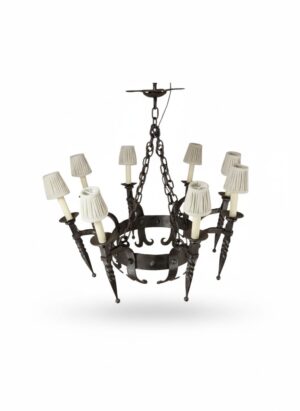













A Gothic lantern is a hanging or wall-mounted lantern designed in the Gothic or Gothic Revival style, with pointed arches, tracery panels, crocketed pinnacles, quatrefoils and other motifs borrowed from medieval architecture. Most are made of wrought iron, brass, bronze or gilt metal with glazed panels, and they may be square, hexagonal or octagonal, often with a crown-like top and a pierced corona.
True medieval lanterns rarely survive, and most Gothic lanterns on the market date from the nineteenth century, when the Gothic Revival transformed church furnishing and domestic architecture. A.W.N. Pugin, working with the Birmingham firm of John Hardman, designed ecclesiastical metalwork in a convincing medieval idiom, and lanterns of this type were fitted to churches, chapels, college halls and country-house halls. Many were made for candles or gas and later converted to electricity. Collectors look for crisp casting or hand-forged detail, original glass, which may be coloured or etched, and fine proportions. Lanterns with their original smoke bells, chains and ceiling roses are more desirable, while replaced glazing and poor rewiring should be checked. A Gothic lantern brings drama to a stairwell, porch or vaulted entrance hall, and a pair can frame a doorway handsomely.