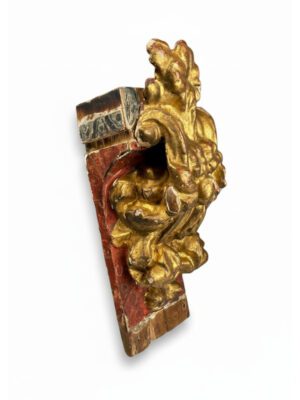
A volute is a spiral, scroll-shaped ornament resembling a rolled-up piece of parchment or the coil of a shell. It is most closely associated with the capital of the Ionic column, whose two large volutes are its defining feature, but it also appears in smaller form on Corinthian and Composite capitals and in a wide range of architectural and decorative contexts.
The volute derives from ancient Greek architecture and was revived in the Renaissance, becoming a standard element of the classical vocabulary used by architects, carvers and furniture makers for centuries. In architecture, volutes appear on consoles and brackets supporting cornices and balconies, on the scrolled sides of Baroque church façades and at the foot of staircases, where the handrail curls round into a volute above a curtail step. In furniture, they are seen on the scrolled arms of sofas and chairs, the terminals of chair backs, carved table supports and the pediments of cabinets and bookcases, and they are prominent in Regency, William IV and Victorian design. Volutes also appear in silver, bronze and ceramics, on handles and feet. When judging carving, collectors look for a smooth, even spiral and crisp detail, as clumsily cut volutes reveal inferior work. The form remains central to classical joinery today.