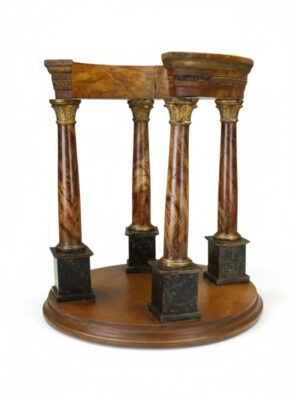
A column base is the lowest part of a column, between the shaft and the plinth or floor on which it stands. It spreads the load of the column, provides a visual foundation, and usually consists of a series of mouldings, such as convex torus rings and concave scotia hollows, whose design varies according to the architectural order.
In classical architecture, Greek Doric columns had no base at all, standing directly on the stylobate, while the Ionic and Corinthian orders were given moulded bases. The most widely used form, the Attic base, comprises two tori separated by a scotia and was adopted for many orders by Roman and Renaissance architects. Tuscan bases are simpler, with a single torus on a square plinth. Column bases are found in stone, marble, timber, cast iron, plaster and scagliola, and their profiles help historians identify the period and style of a building. On the architectural salvage market, carved stone and marble column bases are sought for use as pedestals for sculpture, plinths for garden urns or bases for tables, and they also appear in miniature on clocks, lamps and furniture in Neoclassical taste.