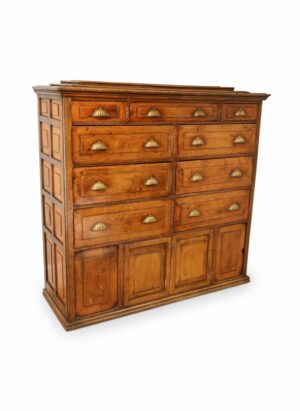
Pear wood is the timber of the pear tree, a fine-grained, close-textured fruitwood with a pale pinkish-brown colour and very little visible figure. Its even density makes it easy to carve and turn crisply in any direction, and it takes stain and polish exceptionally well.
Because pear trees rarely yield large boards, the wood was used mainly for small items and details rather than whole carcasses. It was a favourite for carved frames, moulds, treen, musical instruments, drawing instruments and the turned components of country chairs, and it appears in English, French and German provincial furniture. Its ability to take a deep black stain made it the classic substitute for ebony, and much ebonised furniture, picture frames and stringing of the seventeenth to nineteenth centuries is in fact stained pear wood. Black Forest carvers and makers of small boxes also used it widely. Mature pear wood develops a warm honey tone with age and handling. Collectors value it for its silky surface, and when assessing a piece look for an even, mellow colour, crisp original carving and the absence of worm, to which fruitwoods are particularly prone.