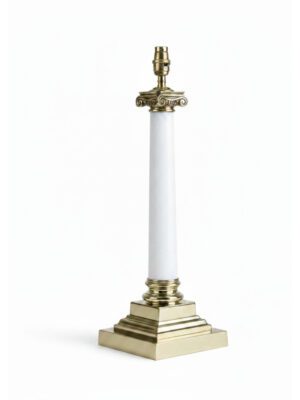
An Ionic capital is the crowning element of a column of the Ionic order, instantly recognised by the pair of spiral scrolls, called volutes, that curl down on either side. Between the volutes sits a moulded band, the echinus, usually carved with egg-and-dart ornament, and above it a thin, flat abacus that supports the entablature.
The Ionic order originated in ancient Greece, in the region of Ionia in Asia Minor, and was later adopted and adapted by the Romans. Described by the Roman writer Vitruvius, it was codified in the Renaissance by Serlio and Palladio, and it became a staple of Palladian and Neoclassical architecture in Britain during the eighteenth century. Variations include capitals with volutes on all four corners, sometimes called angular or Scamozzi capitals. Beyond buildings, the Ionic capital appears throughout the decorative arts on chimneypieces, bookcases, clock cases, mirror frames, column-form lamps and garden ornaments. Antique architectural capitals in stone, carved wood, plaster or cast iron are collected as salvage and sculptural objects. Buyers should look for crisp carving, good proportions and authentic weathering, as reproductions in cast resin or composition are common.