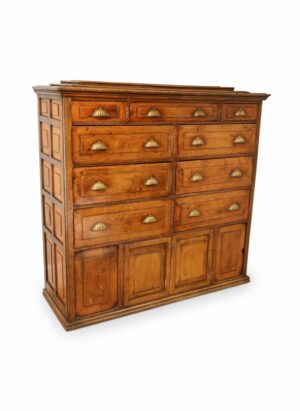
A brushing slide is a shallow pull-out board fitted immediately beneath the top of a chest of drawers, which can be drawn out to provide an extra flat surface. It is thought to have been used for laying out and brushing clothes, and also served as a convenient surface for folding garments or setting down small objects while dressing.
Brushing slides are particularly associated with good-quality English chests of drawers of the Georgian period, especially the mahogany chests and bachelor's chests of the mid-eighteenth century. The slide is usually veneered or made from solid timber to match the case, with a moulded or cross-banded front edge and small brass knobs or pulls, and it runs on bearers within the carcase. Collectors regard a brushing slide as a desirable feature that adds both practicality and value. When examining a chest, check that the slide is original rather than a later conversion of a top drawer, that it runs smoothly, and that its surface, often protected from light, shows a colour consistent with age. The surface of an original slide can reveal how much the top above has faded over the centuries.